The World Bank remains one of Kenya’s most important development financing partners, providing billions of dollars in loans and credits to support infrastructure, healthcare, education, climate resilience, public finance, and economic reforms. As of July 2026, World Bank financing to Kenya generally comes with two broad categories of conditions:
Financial repayment terms, which determine how and when Kenya repays borrowed funds.
Policy reform conditions, which require the government to implement agreed structural, institutional, or legal reforms before or during loan disbursement.
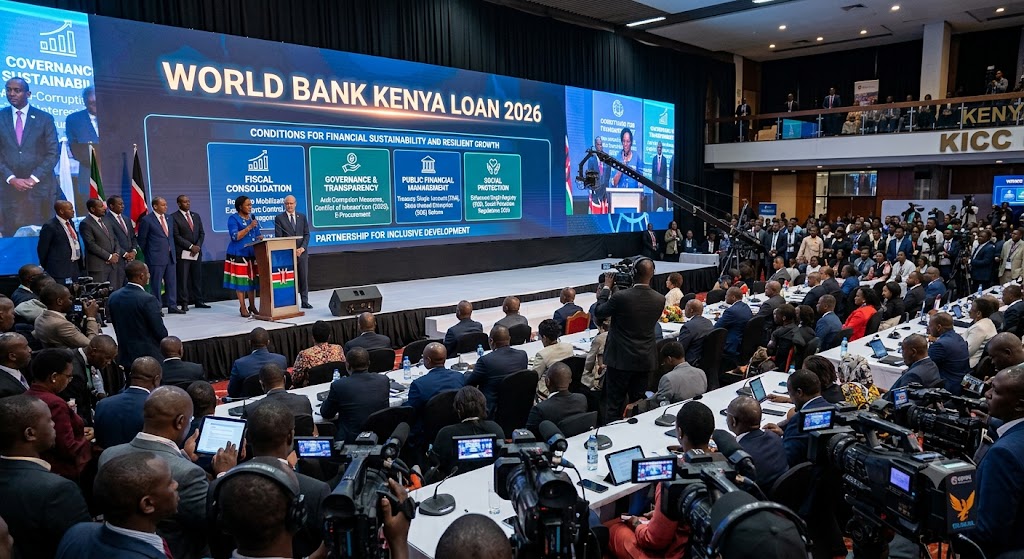
Understanding these conditions helps explain how World Bank financing works, why reforms are often linked to loans, and how these agreements affect Kenya’s economy and public sector.
Understanding World Bank Lending to Kenya
The World Bank finances Kenya through two primary lending windows:
International Development Association (IDA) – provides concessional financing designed for lower-income and eligible countries.
International Bank for Reconstruction and Development (IBRD) – provides financing on less concessional, market-based terms for countries with stronger credit profiles.
Kenya currently receives financing from both windows, reflecting its economic status and development financing needs.
Financial Conditions of World Bank Loans to Kenya

The first category of conditions concerns the financial obligations attached to borrowing.
- Low Interest Rates
Most IDA financing carries very low interest costs compared to commercial borrowing.
These concessional loans are designed to:
Reduce debt servicing costs
Support long-term development
Allow governments to invest in public services without facing immediate repayment pressure
Some IDA credits are interest-free but include small administrative charges.
- Commitment Fees
World Bank loans typically include a commitment fee of approximately 0.25% per year on undisbursed loan balances.
This fee encourages timely implementation of projects by charging borrowers for funds that have been committed but not yet withdrawn.
- Service Charges
IDA credits generally include a service charge of around 0.75% annually.
Unlike commercial interest rates, service charges help cover administrative costs rather than generating profit.
- Long Grace Periods
One of the biggest advantages of World Bank concessional financing is the lengthy grace period.
During this period:
Kenya generally does not repay the principal.
The government focuses on implementing projects.
Only applicable charges or limited payments may be due.
Grace periods often extend for several years before principal repayments begin.
- Extended Repayment Schedules
World Bank loans typically provide long repayment periods that may extend over several decades.
Long maturities:
Lower annual repayment obligations
Improve debt sustainability
Support investments with long-term economic benefits
This makes World Bank financing significantly cheaper than many commercial loans.
- Non-Concessional IBRD Terms
IBRD financing differs from IDA financing because it is offered on less concessional terms.
IBRD loans generally feature:
Market-based interest rates
Variable or fixed pricing options
Shorter repayment periods than IDA
Standard commitment and financing charges
Kenya may access IBRD financing for projects where concessional resources are limited or where its borrowing profile qualifies.
Policy Reform Conditions Attached to Budget Support
Beyond financial terms, some World Bank loans—particularly Development Policy Operations (DPOs)—require the implementation of agreed policy reforms.
Unlike investment loans, which finance specific projects, DPOs support government budgets while encouraging reforms intended to strengthen economic management and public institutions.
Common Policy Conditions for Kenya
- Expansion of Social Protection Systems
One recurring reform area has been strengthening Kenya’s social protection framework.
Typical requirements include:
Expanding social protection registries
Improving beneficiary identification
Enhancing digital payment systems
Increasing transparency in social assistance programmes
The goal is to improve targeting and ensure support reaches vulnerable households more effectively.
- Improving Tax Administration
Another major reform area involves strengthening domestic revenue collection.
Common policy actions include:
Modernising tax administration
Expanding electronic tax systems
Improving compliance
Reducing tax leakages
Enhancing efficiency at the Kenya Revenue Authority
Better tax administration helps increase government revenue without necessarily raising tax rates.
- Increasing Forest Cover
Climate and environmental reforms have become increasingly important components of World Bank-supported programmes.
Typical commitments include:
Expanding national forest cover
Restoring degraded ecosystems
Promoting sustainable land management
Improving environmental governance
These reforms support climate resilience while helping Kenya meet environmental objectives.
- Public Finance Management Reforms
The World Bank frequently supports improvements in how public funds are managed.
Policy measures may include:
Strengthening budget transparency
Improving expenditure controls
Enhancing procurement systems
Increasing accountability
Improving debt management practices
Effective public financial management helps ensure government resources are used efficiently.
- Climate Change Legislation
Climate policy has become an increasingly important area of reform.
Conditions may involve:
Implementing climate change frameworks
Strengthening climate governance
Developing adaptation strategies
Supporting low-carbon development
Integrating climate considerations into public investment planning
These reforms aim to improve resilience while supporting sustainable economic growth.
- Competition Law Reforms
Development Policy Operations have also supported reforms aimed at improving competition within Kenya’s economy.
Examples include amendments to competition legislation that seek to:
Improve market efficiency
Encourage fair competition
Protect consumers
Reduce anti-competitive practices
Promote private sector investment
Such legal reforms are intended to foster a more competitive business environment.
Why Does the World Bank Attach Policy Conditions?
Policy conditions are intended to ensure that borrowed funds are supported by reforms that improve governance and strengthen institutions.
The World Bank generally aims to:
Improve economic management
Enhance transparency
Increase accountability
Strengthen public institutions
Promote sustainable development
Encourage long-term economic growth
Rather than focusing solely on funding projects, policy-based lending seeks to support broader institutional improvements.
Benefits of World Bank Loan Conditions
Supporters of World Bank conditional lending argue that these conditions provide several advantages.
Lower Borrowing Costs
Concessional financing is significantly less expensive than commercial borrowing.
Better Public Financial Management
Reforms can strengthen budgeting, procurement, and financial accountability.
Stronger Social Protection
Improved registries and delivery systems can help social assistance reach intended beneficiaries more efficiently.
Increased Investor Confidence
Legal and institutional reforms may improve the investment climate by promoting transparency and regulatory certainty.
Environmental Sustainability
Climate and forestry reforms contribute to long-term environmental resilience and sustainable resource management.
Challenges and Criticisms
World Bank loan conditions have also attracted debate.
Some critics argue that:
Policy reforms can reduce national policy flexibility.
Reform implementation may be politically difficult.
Administrative capacity can limit the speed of implementation.
Some reforms may impose short-term adjustment costs before longer-term benefits are realised.
Supporters, however, contend that carefully designed reforms improve governance, strengthen institutions, and enhance the long-term effectiveness of public spending.
How Development Policy Operations Differ from Investment Loans
Investment Loans Development Policy Operations
Finance specific projects Support the national budget
Build infrastructure and public services Support economic and institutional reforms
Focus on project implementation Focus on agreed policy actions
Funds tied to project activities Disbursements linked to completion of policy reforms
Frequently Asked Questions
Does every World Bank loan require policy reforms?
No. Investment project financing primarily supports specific development projects, while Development Policy Operations typically include agreed policy and institutional reform actions.
Are World Bank loans interest-free?
Not all. Many IDA credits offer highly concessional terms with low service charges, while IBRD loans generally carry market-based interest rates and less concessional repayment terms.
What is a commitment fee?
A commitment fee is a charge—commonly around 0.25%—applied to the undisbursed portion of an approved loan to encourage timely use of committed funds.
Why are social protection reforms often included?
Strengthening social protection systems helps governments identify eligible beneficiaries more accurately and improve the efficiency and transparency of assistance programmes.
Why does the World Bank support tax administration reforms?
Improving tax administration can increase domestic revenue collection, reduce leakages, and strengthen the government’s ability to finance public services sustainably.
Conclusion
As of July 2026, World Bank loans to Kenya generally combine favourable financial repayment terms with policy reform commitments. Financial conditions often include low-cost IDA financing, commitment fees of around 0.25%, service charges of approximately 0.75%, extended grace periods, and long repayment schedules. Where Kenya receives budget-support financing through Development Policy Operations, disbursements are commonly linked to agreed reforms in areas such as social protection, tax administration, public financial management, environmental sustainability, competition policy, and climate governance.
Together, these financial and policy conditions are intended to support Kenya’s development priorities while promoting stronger institutions, improved governance, and sustainable long-term economic growth. The specific terms and reform requirements, however, vary by financing instrument and are negotiated individually for each approved World Bank operation.