The rising cost of petrol has made fuel expenses a major challenge for Kenyan motorists, ride-hailing drivers, taxi operators, matatu owners and businesses that operate vehicle fleets. For drivers who cover many kilometres every day, fuel costs can significantly reduce monthly income and business profits.
One option gaining attention in Kenya is autogas conversion — converting a petrol-powered vehicle to a dual-fuel system that can operate using both LPG (Liquefied Petroleum Gas) and petrol.
The main challenge, however, is the upfront cost of purchasing and installing the LPG conversion system.
To address this barrier, Equity Bank and Proto Energy’s OTOGAS have partnered around financing for vehicle autogas conversions, giving eligible motorists and businesses an opportunity to finance the conversion rather than paying the entire cost upfront.
This guide explains what an autogas conversion loan is, who may qualify, how the application process works, what documents you may need, and the important factors to consider before borrowing.
What Is an Autogas Conversion Loan in Kenya?
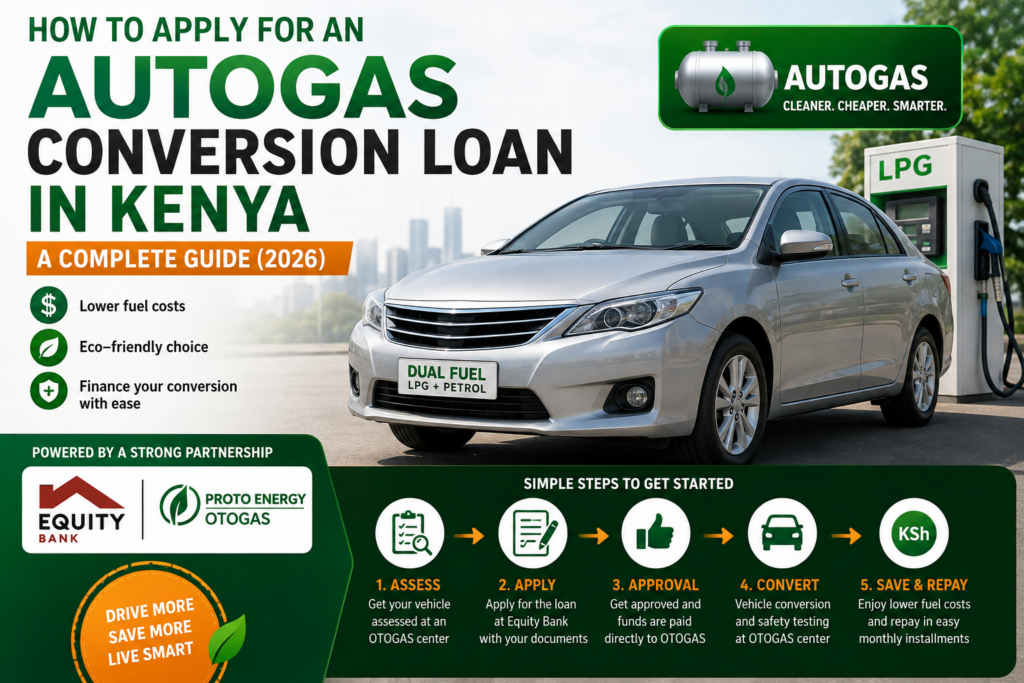
An autogas conversion loan is financing designed to help eligible vehicle owners meet the cost of converting a petrol vehicle to a dual-fuel LPG/petrol system.
Instead of paying the entire conversion cost from your savings, the eligible borrower can finance the expense and repay the loan according to the agreed terms.
Once the conversion has been completed, the vehicle can operate on LPG or petrol, depending on the system and operating conditions.
The financing can be particularly relevant to people who use their vehicles intensively and therefore have substantial monthly fuel expenses.
Who Can Benefit From Autogas Financing?
An autogas conversion loan may be useful for:
- Private motorists who want to reduce vehicle running costs
- Uber, Bolt and other ride-hailing drivers
- Taxi operators
- Matatu and other PSV operators
- Small and medium-sized businesses
- Companies operating vehicle fleets
- Business owners whose vehicles consume significant amounts of petrol
For high-mileage motorists, even relatively small savings on each litre can become meaningful over hundreds or thousands of kilometres.
How Does an LPG Vehicle Conversion Work?
During an autogas conversion, an approved technician installs an LPG fuel system alongside the vehicle’s existing petrol system.
The resulting vehicle is generally referred to as a dual-fuel vehicle because it can use both LPG and petrol.
A typical conversion involves equipment such as:
- LPG storage equipment
- Fuel delivery components
- Appropriate regulators and valves
- Electronic control components where applicable
- Safety systems
- Associated pipes, fittings and installation components
The exact equipment required depends on the vehicle’s make, model, engine and technical condition.
For this reason, motorists should have their vehicles professionally assessed rather than assuming that every petrol vehicle can be converted in exactly the same way.
Who Is Eligible for an Autogas Conversion Loan?
Eligibility ultimately depends on the lender’s current credit policies and the individual applicant’s circumstances. However, the financing arrangement is intended to serve several categories of motorists and businesses.
1. Individual Vehicle Owners
Private motorists with qualifying petrol-powered vehicles may be able to apply for financing to cover the conversion cost.
2. Ride-Hailing Drivers
Drivers working with platforms such as Uber and Bolt can be potential beneficiaries because they often cover substantial distances and therefore spend heavily on fuel.
3. Taxi and PSV Operators
Taxi businesses, matatu owners and other PSV operators can explore autogas financing as a way of managing vehicle operating expenses.
4. SMEs
Small and medium-sized businesses that rely on vehicles for deliveries, transportation or other operations can consider financing individual conversions or potentially multiple vehicles, subject to the lender’s requirements.
5. Corporate Fleet Operators
Businesses with several petrol-powered vehicles may also explore financing options for reducing fleet fuel expenses.
Basic Vehicle Requirements
The vehicle normally needs to be a petrol-powered vehicle suitable for LPG conversion.
A technical assessment is important because vehicle compatibility can depend on factors such as:
- Vehicle make and model
- Engine type
- Engine condition
- Existing fuel system
- Mechanical condition
- Availability of an appropriate conversion system
A vehicle inspection by an authorised or qualified conversion centre should therefore be completed before proceeding with financing.
Documents You May Need
Applicants should prepare their documentation before beginning the process.
Depending on the applicant and lender requirements, documents may include:
- Kenyan National ID
- KRA PIN
- Vehicle logbook or registration documentation
- Proof of income
- Recent bank statements
- Payslips for employed applicants
- Business records or statements for self-employed applicants
- Relevant business or fleet documentation where applicable
- Official autogas conversion quotation
The exact documents required can vary depending on whether you are applying as an individual, employed person, self-employed business owner or company.
Step-by-Step: How to Apply for an Autogas Conversion Loan in Kenya
Step 1: Have Your Vehicle Assessed
The first step is to visit a certified OTOGAS/Proto Energy conversion centre or another authorised facility involved in the financing arrangement.
A technician should assess your vehicle to determine whether it is suitable for conversion.
Do not purchase equipment or pay for installation before confirming the technical requirements and financing process.
Step 2: Get an Official Conversion Quotation
After the assessment, the conversion provider can prepare a quotation based on the equipment and installation requirements for your vehicle.
The quotation is important because it establishes the expected cost of the conversion.
Before accepting it, ask for clarification about what is included, such as:
- LPG equipment
- Installation
- Testing
- Calibration or tuning
- Safety checks
- Applicable taxes or additional charges
Understanding the complete cost can help you avoid unexpected expenses.
Step 3: Prepare Your Financial Documents
Collect your identification and financial documents before approaching Equity Bank.
These may include your ID, KRA PIN, vehicle documents and evidence showing your ability to repay the facility.
For employed applicants, this could include payslips and bank statements.
For self-employed applicants, business statements and other evidence of income may be relevant.
Step 4: Submit Your Application to Equity Bank
With the conversion quotation and supporting documents ready, approach Equity Bank through the appropriate channel and request information about the available autogas conversion financing.
You may be required to complete a credit application and provide additional information.
The bank will assess your application according to its lending and credit requirements.
Step 5: Wait for Credit Assessment and Approval
Equity Bank may consider factors such as:
- Your income
- Ability to repay
- Existing financial obligations
- Banking history
- Credit history
- Value and details of the proposed conversion
- Vehicle documentation
- Information contained in the conversion quotation
Approval is not automatic. Having an eligible vehicle does not necessarily mean every applicant will qualify for financing.
Step 6: Financing and Payment to the Conversion Provider
Where the facility is approved, the financing arrangement may involve payment directly to the approved conversion provider rather than giving the borrower the money as unrestricted cash.
This helps ensure that the financing is used for the intended vehicle conversion.
Applicants should confirm the exact disbursement procedure with Equity Bank before signing the agreement.
Step 7: Complete the LPG Conversion
Once the financing and installation arrangements are confirmed, the vehicle can undergo the conversion.
Qualified technicians should install the LPG system and perform the necessary safety and operational checks.
The vehicle should be properly tested and calibrated before being returned to normal use.
Step 8: Begin Repaying the Loan
After the financing is utilised, you will be required to make repayments according to the agreed schedule.
Your loan agreement should clearly state:
- Amount borrowed
- Interest rate
- Loan tenure
- Monthly repayment
- Applicable fees and charges
- Total amount payable
- Late-payment consequences
- Early-repayment terms, where applicable
Always read the financing agreement carefully before accepting the facility.
How Much Can You Borrow?
The amount available depends on the actual cost of the vehicle conversion and the lender’s assessment.
It is therefore important not to assume that every applicant will receive the same loan amount.
Your official OTOGAS quotation can provide the starting point for determining how much financing may be required, while Equity Bank’s credit assessment determines the amount and terms that can actually be approved.
What Is the Interest Rate?
The applicable interest rate, fees and repayment period should be confirmed directly with Equity Bank at the time of application.
Loan pricing can change, and the terms offered to one applicant may not necessarily be identical to those offered to another.
Before signing, ask for the total cost of credit, rather than focusing only on the monthly repayment.
Why Consider Financing an Autogas Conversion?
Lower Upfront Financial Burden
The biggest advantage of financing is that you do not necessarily have to pay the entire conversion cost from your savings at once.
Instead, the cost can be spread across the agreed repayment period.
Potential Fuel Savings
LPG can be less expensive than petrol in many circumstances. This can create an opportunity for motorists to reduce their fuel expenditure.
However, actual savings depend on LPG prices, petrol prices, vehicle consumption, driving patterns and other operating costs.
Particularly Relevant to High-Mileage Drivers
A driver who travels a few kilometres per week may take much longer to recover the conversion cost through fuel savings.
By comparison, a driver who spends many hours on the road every day may potentially see greater savings because of higher fuel consumption.
Reduced Pressure on Business Cash Flow
For businesses operating vehicles, financing may make it easier to spread the cost of the conversion instead of making one large capital expenditure.
How Long Does It Take to Recover the Conversion Cost?
There is no single answer because the payback period depends on individual circumstances.
You can estimate it using:
Payback Period = Total Conversion Cost ÷ Estimated Monthly Fuel Savings
For example, if a conversion costs KSh 100,000 and you estimate that it will save KSh 10,000 per month in fuel costs, the simple payback period would be approximately 10 months.
This is only an illustration. It does not include financing costs, maintenance, LPG price changes or other expenses.
Example: Calculating Potential Savings
Suppose a ride-hailing driver currently spends KSh 30,000 per month on petrol.
After conversion, the driver’s estimated equivalent LPG expenditure is KSh 20,000 per month.
The potential gross fuel saving would be:
KSh 30,000 − KSh 20,000 = KSh 10,000 per month
Over 12 months:
KSh 10,000 × 12 = KSh 120,000
Again, this is an example rather than a guaranteed saving. Actual results can differ substantially depending on fuel prices, driving habits and vehicle performance.
Important Questions to Ask Before Taking the Loan
Before signing any financing agreement, ask the lender and conversion provider:
- What is the total cost of the conversion?
- How much will I repay in total?
- What interest rate applies?
- What is the loan tenure?
- What will my monthly repayment be?
- Are there processing or other additional fees?
- Is there a penalty for early repayment?
- What happens if I miss a repayment?
- Who handles maintenance of the LPG system?
- What warranty is provided for the conversion equipment?
- What happens if the vehicle is sold before the loan is fully repaid?
- Are there any insurance or documentation requirements?
Getting clear answers before borrowing can help you make a more informed decision.
Important Tips Before Applying
Confirm Vehicle Compatibility
Do not assume that every petrol vehicle should be converted.
Have the vehicle professionally assessed first.
Compare the Numbers
Calculate how much you currently spend on petrol and estimate your expected LPG expenditure.
Then compare your projected fuel savings with the loan repayment.
Understand the Total Cost
A low monthly instalment can sometimes appear attractive while the total repayment is significantly higher.
Always compare the total amount repayable.
Keep Your Vehicle in Good Condition
An LPG conversion does not eliminate the need for normal vehicle maintenance.
Regular servicing and proper mechanical maintenance remain important.
Use Qualified Technicians
Because LPG is a pressurised fuel system, installation and maintenance should be handled by appropriately qualified professionals.
Avoid informal installations simply because they appear cheaper.
Verify Current Financing Terms
Loan terms, eligibility criteria, interest rates and fees can change.
Always confirm the latest information directly with Equity Bank and the authorised OTOGAS provider before submitting an application.
Autogas Conversion Loan vs Paying Cash
| Feature | Financing | Paying Cash |
|---|---|---|
| Upfront cost | Lower | Higher |
| Monthly loan repayment | Yes | No |
| Interest/financing cost | Applicable where charged | None |
| Immediate fuel savings | Potentially | Potentially |
| Impact on savings | Lower initial withdrawal | Larger initial withdrawal |
| Credit assessment | Usually required | Not required |
| Best suited for | Those who prefer spreading the cost | Those with sufficient savings |
Neither option is automatically better for everyone.
If you have enough savings and want to avoid financing costs, paying cash may be attractive.
If paying the full conversion cost would strain your finances, financing may provide a way to spread the expense.
Is an Autogas Conversion Loan Worth It?
It can be worth considering if you:
- Spend heavily on petrol every month
- Drive long distances regularly
- Operate a ride-hailing or taxi vehicle
- Run a matatu or PSV business
- Operate a business fleet
- Have a vehicle that is technically suitable for conversion
- Can comfortably afford the monthly loan repayment
However, the decision should be based on your own numbers rather than simply assuming LPG will automatically save money.
Frequently Asked Questions
What is an autogas conversion loan?
It is financing that can help eligible vehicle owners pay for the conversion of a petrol vehicle to a dual-fuel LPG/petrol system.
Can Uber and Bolt drivers apply?
Ride-hailing drivers may be among the target users of the financing arrangement, subject to the applicable eligibility and credit requirements.
Can a matatu owner apply?
PSV and matatu operators may also explore the financing option, provided they meet the lender’s requirements and their vehicles are suitable for conversion.
Do I need an Equity Bank account?
An Equity Bank relationship may be required for servicing the facility. Confirm the current account and application requirements directly with the bank.
Does the loan money come directly to the borrower?
The financing arrangement may involve payment directly to the approved conversion provider. Confirm the current disbursement process with Equity Bank.
Can any petrol vehicle be converted?
No. Vehicle compatibility should be confirmed through a professional technical assessment before conversion.
Is LPG cheaper than petrol?
LPG can offer lower running costs than petrol in many situations, but the actual savings depend on current fuel prices, vehicle efficiency, LPG consumption and driving patterns.
How do I know whether conversion will save me money?
Compare your current monthly petrol expenditure with the projected LPG cost and then factor in the conversion price and total financing cost.
Final Thoughts
The Autogas Conversion Loan in Kenya provides an alternative way for motorists and businesses to finance the transition from petrol-only vehicles to dual-fuel LPG/petrol systems.
For high-mileage drivers, ride-hailing operators, PSV owners and businesses with vehicle fleets, reducing fuel expenses can have a meaningful effect on operating costs. However, the financial benefit depends on the vehicle, fuel prices, mileage, conversion cost and loan terms.
The best approach is to start with a professional vehicle assessment, obtain a detailed OTOGAS quotation, and then discuss the available financing and repayment terms with Equity Bank.
Most importantly, do not judge the loan solely by the advertised monthly payment. Consider the total cost of borrowing, expected fuel savings, repayment period and your ability to meet the instalments.
If the numbers work in your favour and your vehicle is suitable for conversion, autogas financing could provide a practical way to reduce fuel costs without paying the entire conversion expense upfront.
Disclaimer: This article is for informational purposes only and should not be treated as financial advice. Loan availability, eligibility criteria, interest rates, fees, repayment periods and vehicle-conversion requirements may change. Confirm the latest terms directly with Equity Bank and the authorised OTOGAS/Proto Energy representatives before applying.