Having a poor credit history can make it difficult to qualify for a loan in Kenya. You may have missed previous loan repayments, defaulted on a digital loan, accumulated unpaid mobile loans, or received an adverse listing with a Credit Reference Bureau (CRB).
However, having a poor credit history does not automatically mean that you can never qualify for credit again. Lenders consider different factors when assessing applications, including your income, existing financial commitments, repayment history, and ability to repay a new loan.
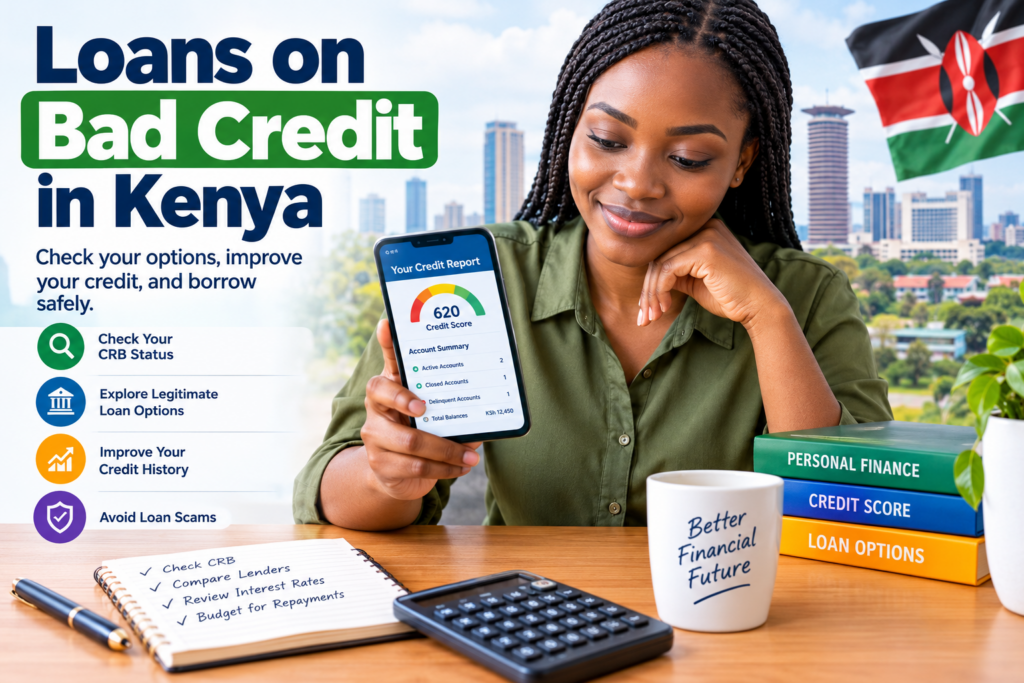
If you are looking for loans on bad credit in Kenya, this guide explains how credit assessments work, what options may be available, how to check your CRB status, and how to avoid fraudulent lenders.
We also discuss the importance of choosing regulated financial institutions and rebuilding your credit history before applying for additional borrowing.
Important: Loan approval is never guaranteed, and no legitimate lender can promise approval solely because you have a bad credit score.
What Is a Bad Credit History?
Bad credit refers to a record of borrowing that may make financial institutions consider you a higher-risk borrower.
In Kenya, lenders may use information from Credit Reference Bureaus, commonly known as CRBs, alongside other financial information to evaluate loan applications.
Your credit history may be affected by:
- Late loan repayments.
- Unpaid mobile loans.
- Defaulted bank or microfinance loans.
- Outstanding digital credit.
- Repeated failure to meet repayment obligations.
- Incorrect or outdated information on your credit report.
Nevertheless, a poor credit history does not tell the entire story of your financial situation.
Some lenders may consider applicants with previous repayment difficulties if they can demonstrate that their circumstances have improved.
Does Being Listed on CRB Mean You Cannot Get a Loan?
No. Being listed on a CRB does not automatically prevent you from obtaining every type of loan in Kenya.
According to the Central Bank of Kenya (CBK), a customer’s credit score should not be used as the sole reason for denying a loan. Lenders may consider other factors when evaluating an application.
However, an adverse credit history can still affect your eligibility, the amount offered, the interest rate, or the repayment conditions.
You can learn more about credit information sharing through the official Central Bank of Kenya website.
1. Check Your CRB Status Before Applying for a Loan
Before looking for credit, find out what your credit report says about you.
Applying for several loans without understanding your credit history may lead to repeated rejections and additional financial pressure.
How to Check Your CRB Status in Kenya
You can request your credit report from a licensed Credit Reference Bureau.
Kenya’s credit information framework provides for consumers to receive a free copy of their credit report at least once a year.
Your report can help you identify:
- Whether your credit record contains adverse information.
- Which credit accounts have been reported.
- Whether a reported loan remains outstanding.
- Whether your personal information is accurate.
- Whether an entry needs to be disputed.
For current information about licensed credit reference bureaus, visit the CBK website.
What Should You Do If Your CRB Report Contains an Error?
If you discover a loan you never borrowed, an incorrect outstanding balance, or a repayment that has not been recorded, contact the lender and the relevant bureau to dispute the information.
Keep copies of repayment receipts, transaction messages, account statements, and any correspondence with the lender.
Do not pay an unknown person who claims they can remove your name from CRB immediately. Use the official dispute process instead.
2. Consider the Hustler Fund if You Meet the Eligibility Requirements
The Hustler Fund is a government financial inclusion initiative that provides eligible Kenyans with access to credit and savings facilities.
It may be worth investigating if you need a small loan and meet the applicable eligibility requirements.
Hustler Fund Loan Limits
The personal loan product provides limits determined by a borrower’s credit assessment, with a maximum of KSh 50,000 under the published product terms.
The amount available to an individual varies. You should not assume that you will receive the maximum limit.
Hustler Fund Interest Rate
The published personal loan terms specify an interest rate capped at 8% per annum, calculated on a prorated basis.
The official programme also states that 5% of an approved loan is allocated to savings, while 95% is disbursed to the borrower’s mobile money account.
For example, if you are approved for KSh 1,000, KSh 950 is disbursed and KSh 50 is allocated to savings.
How to Apply
Eligible customers can access the personal loan product through the Hustler Fund’s official channels, including USSD.
- Dial *254# on your mobile phone.
- Select the relevant Hustler Fund option.
- Follow the prompts to check your eligibility.
- Review the loan amount and applicable terms.
- Accept the offer only if you understand the repayment obligations.
Eligibility and the amount offered depend on the programme’s requirements and assessment process.
Official website: Hustler Fund Kenya
3. Explore SACCO Loans if You Are an Eligible Member
Savings and Credit Cooperative Organisations (SACCOs) provide loans to eligible members under their respective lending policies.
If you belong to a registered SACCO, ask whether you qualify for a loan based on your savings, membership history, income, and ability to repay.
Some SACCOs use guarantors or savings as part of their lending arrangements.
However, requirements vary. A SACCO may still consider your credit history, and membership alone does not guarantee approval.
Common SACCO Loan Requirements
Depending on the institution, you may need:
- Valid identification.
- Active SACCO membership.
- Regular savings contributions.
- Proof of income or business activity.
- Guarantors or acceptable security.
- Completed application forms.
- Evidence that you can meet the repayment schedule.
Advantages of SACCO Borrowing
- You may already have an established relationship with the institution.
- Some products offer structured repayment arrangements.
- Members may have access to loans linked to their savings or guarantors.
- You can ask questions and review the loan agreement before accepting an offer.
Before applying, confirm the SACCO’s registration, current loan terms, applicable fees, and eligibility criteria.
4. Ask Your Existing Bank About Your Options
If you already have a bank account, consider speaking to your bank before approaching an unfamiliar lender.
Your bank may be able to explain why a previous application was rejected and whether any suitable credit products are available.
The bank may consider your account activity, verified income, outstanding debts, credit history, and other information when reviewing your application.
However, having an account with a bank does not guarantee access to a loan.
What to Ask Your Bank
Consider asking:
- Is my credit history affecting my eligibility?
- Can I correct any inaccurate information on my credit report?
- What documents would help demonstrate my current income?
- Are there suitable credit products for my financial circumstances?
- What is the total cost of borrowing?
- Can I apply again after addressing the issues identified in my previous application?
Avoid borrowing simply to improve your credit record. Only take a loan when the purpose is necessary and you can reasonably afford the repayments.
5. Consider a Licensed Digital Credit Provider
Kenya has a digital lending market that includes mobile applications and other online credit services.
Some licensed providers may consider different factors when assessing applicants. However, you should never assume that a digital lender will approve you because you have poor credit.
How to Identify a Licensed Digital Lender
Before submitting an application, check the provider against the current CBK directory of licensed Digital Credit Providers.
You can find the directory through the Central Bank of Kenya’s official digital credit provider page.
Check the following details:
- The lender’s legal company name.
- Whether the provider is currently licensed.
- The official application or website.
- The advertised loan amount.
- The interest rate and all applicable fees.
- The repayment period.
- The lender’s customer support details.
- Its privacy and complaints procedures.
Remember that a licence does not mean every loan product will suit your circumstances.
Be Careful With No-CRB-Check Loan Advertisements
You may encounter advertisements claiming that borrowers can obtain instant loans without a CRB check.
Treat these claims cautiously.
A lender may use different eligibility assessments, but an advertisement promising guaranteed approval regardless of repayment history should not be accepted without verification.
Never pay an upfront release fee to an unknown person who promises to secure a loan for you.
6. Consider Employer-Based Financial Assistance
If you are employed, you may be able to discuss financial assistance with your employer.
Depending on the organisation’s policies, available arrangements could include a salary advance or an employee assistance facility.
This may be worth exploring before taking a high-cost digital loan.
However, an employer is not required to provide an advance, and any deduction or repayment arrangement should be clearly documented.
Before agreeing, confirm:
- The amount you will receive.
- Any administrative charges or interest.
- When the amount must be repaid.
- How repayments will affect your future salary.
- Whether the arrangement complies with your employment terms.
Do not share your banking passwords, mobile money PIN, or one-time verification codes with anyone claiming to arrange an employer loan.
7. Ask About a Guarantor-Based Loan Where Available
Some financial institutions offer loans supported by guarantors.
A guarantor agrees to take on specified responsibilities if the borrower fails to meet the repayment obligations, subject to the loan agreement.
If you have a poor credit history, a guarantor may help with eligibility under some products. However, this is not guaranteed.
Before choosing this option, make sure that both you and the guarantor understand the agreement.
Important: Never pressure a friend or relative to guarantee a loan they cannot afford to repay if things go wrong.
How to Improve Your Chances of Qualifying for a Loan
If your application has been rejected because of previous repayment difficulties, addressing the underlying issues may be more helpful than submitting additional applications.
1. Settle Outstanding Debts Where Possible
Review your existing debts and contact the relevant lenders to establish the outstanding balances.
If you can afford to repay an overdue loan, request an official settlement figure and obtain confirmation once payment has been processed.
If you cannot pay the full amount immediately, ask whether the lender offers an affordable repayment arrangement.
Do not promise payments that you know you cannot make.
2. Dispute Incorrect CRB Information
Incorrect credit information can affect how a lender assesses an application.
If your report contains errors, use the appropriate dispute process and retain evidence supporting your complaint.
Allow time for the relevant parties to investigate and update the record where necessary.
3. Demonstrate Your Current Ability to Repay
A lender may want evidence that you have a reliable source of income.
Depending on your circumstances, relevant documents may include:
- Recent payslips.
- Bank statements.
- Mobile money transaction records.
- Business records.
- Invoices or payment receipts.
- Other acceptable proof of income.
Submit only genuine documents and provide accurate information.
4. Avoid Submitting Numerous Applications at Once
Applying to multiple lenders without understanding their requirements may expose you to unnecessary fees, unwanted marketing, or unaffordable offers.
Start by checking your credit report and identifying a legitimate institution whose eligibility criteria you can meet.
5. Make a Realistic Repayment Budget
Before accepting a loan, calculate your essential expenses and existing debt repayments.
Only consider borrowing if you can meet the new repayment obligation without sacrificing essential needs such as food, housing, education, and transport.
A loan that appears easy to obtain can still make your financial situation worse if the repayment amount is unaffordable.
Bad Credit Loans in Kenya: What Should You Compare?
Different lending products have different eligibility rules, costs, and risks.
The following table summarises the main options discussed in this guide.
| Loan option | What to check | Important consideration |
|---|---|---|
| Hustler Fund | Eligibility and assigned loan limit | Approval is not guaranteed |
| SACCO loan | Membership, savings, and guarantor requirements | Membership does not guarantee a loan |
| Bank loan | Income, account history, and credit assessment | A bank may reject an application |
| Licensed digital lender | CBK licensing, interest, fees, and repayment period | Avoid assuming all apps accept bad credit |
| Employer-based assistance | Employer policy and repayment conditions | Availability depends on your employer |
| Guarantor-based loan | Guarantor obligations and loan agreement | The guarantor may face financial liability |
Always compare the total repayment amount rather than looking only at the advertised interest rate.
How Much Does a Bad Credit Loan Cost in Kenya?
The cost depends on the lender, loan amount, repayment period, interest rate, and additional charges.
Before accepting an offer, request a clear breakdown of the total amount payable.
For example, suppose a lender offers a loan of KSh 10,000 with a total interest charge of KSh 1,000 and additional fees of KSh 300.
The calculation would be:
- Principal: KSh 10,000
- Interest: KSh 1,000
- Additional fees: KSh 300
- Total repayment: KSh 11,300
This is an illustrative calculation, not an offer from a specific lender.
Ask whether the quoted rate is daily, monthly, or annual, and whether any fees are deducted before disbursement.
A short repayment period can make even a relatively small loan difficult to manage.
Warning Signs of Bad Credit Loan Scams
Borrowers experiencing financial difficulties can be particularly vulnerable to fraudulent loan offers.
Watch out for the following warning signs:
1. Upfront Loan Release Fees
Be cautious if someone demands payment before releasing an approved loan, especially through a personal mobile money number.
Verify all charges directly with the official lender before making any payment.
2. Guaranteed Approval
No legitimate lender should be assumed to approve every applicant regardless of income, identity verification, or repayment ability.
3. Unverified USSD Codes
Do not dial an unfamiliar USSD code simply because a message promises a pre-approved loan.
Confirm the code through the lender’s official website or verified customer support channel.
4. Requests for Your PIN or Password
Never share your mobile money PIN, bank password, or one-time password with a loan agent.
5. Threats and Abusive Collection Practices
If a lender threatens, harasses, or improperly discloses your personal information, keep the relevant messages and transaction records.
You can raise complaints with the appropriate regulator or consumer protection authority.
Frequently Asked Questions About Loans on Bad Credit in Kenya
1. Can I Get a Loan in Kenya if I Have a Bad CRB Record?
Possibly. Your options depend on the lender’s eligibility requirements, your income, current debts, and credit history. A poor record does not automatically mean that every application will be rejected, but approval is never guaranteed.
2. Which Loans Can I Consider if I Have a Poor Credit History?
You can investigate eligible public credit programmes, SACCO products, bank facilities, employer-based assistance, and licensed digital lenders. Each option has different eligibility requirements, and you should verify the terms before applying.
3. Can I Get a Loan Without a CRB Check?
Do not assume that an advertised no-CRB-check loan is genuine or that approval is guaranteed. Verify the lender’s legal status, licensing where applicable, and full loan terms before sharing personal information.
4. Does CRB Listing Permanently Prevent Me From Getting a Loan?
No. A poor credit history does not necessarily prevent you from obtaining credit in the future. However, lenders may continue to consider relevant credit information when assessing applications.
5. How Can I Correct My CRB Record in Kenya?
Obtain your credit report, identify the disputed entry, and contact the relevant lender and credit bureau through their official channels. Provide supporting documents and follow the formal dispute process.
6. Can I Get a Loan if I Am Unemployed?
Some lenders may consider applicants with other verifiable sources of income, but requirements differ. Do not assume that a lender will approve an application without evidence that you can repay the loan.
7. Should I Pay Someone to Remove My Name From CRB?
No. Be wary of individuals who promise immediate CRB clearance for a fee. Use the official dispute process to address errors and contact the relevant lender about outstanding debts.
8. How Can I Rebuild My Credit History?
Start by reviewing your credit report, correcting inaccurate information, addressing outstanding debts where possible, and making agreed repayments on time. Avoid taking new loans that you cannot comfortably afford.
9. Are Digital Loan Apps Safe in Kenya?
Some operate legally, while others may be unlicensed or fraudulent. Check the current CBK directory for digital credit providers and verify the application, legal company name, privacy practices, fees, and repayment terms before applying.
10. What Is the Safest First Step if My Loan Applications Keep Getting Rejected?
Check your credit report and ask a lender why your application was declined, where it is willing to provide that information. Address any errors or outstanding obligations before considering another application.
Final Thoughts
Getting a loan on bad credit in Kenya can be challenging, but a poor credit history does not necessarily close every door to future borrowing.
The most sensible first step is to understand your credit position, identify any errors, and review your current financial obligations.
Depending on your circumstances, you may wish to investigate the Hustler Fund, an eligible SACCO product, your existing bank, employer-based assistance, or a licensed digital credit provider.
Before borrowing, verify the lender’s identity, compare the total repayment cost, and make sure the instalments fit your budget.
Remember: The goal is not simply to obtain another loan. It is to find a legitimate, affordable financial solution that does not deepen your existing financial difficulties.
Disclaimer: This article is for general educational purposes and does not constitute financial or legal advice. Loan eligibility, interest rates, fees, and regulatory requirements may change. Confirm current terms with the relevant institution before making a financial decision.