Kenya’s higher education sector is entering one of its most defining moments in recent history. As the government rolls out its ambitious reforms under the New Higher Education Funding Model, the 2026/2027 financial year is shaping up to be a delicate balancing act between expansion and sustainability.
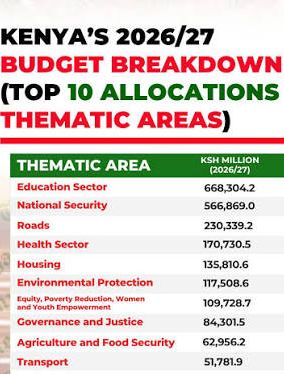
On paper, the government has proposed one of the largest education budgets ever, signaling a commitment to improving access to universities and Technical and Vocational Education and Training (TVET) institutions. Yet beneath the optimism lies a troubling reality: a massive funding gap that threatens the stability of student loans, scholarships, and institutional financing.
For the hundreds of thousands of students who depend on Higher Education Loans Board (HELB) support, the coming academic year could bring both opportunity and uncertainty.
A Record Education Budget — But a Growing Crisis
The Kenyan government has proposed a total education allocation of approximately Sh767 billion for the 2026/2027 financial year. Out of this amount, Sh56.7 billion has been earmarked for the Higher Education Loans Board (HELB) and the Universities Fund (UF).
This marks a notable increase from the Sh41 billion allocated in the previous 2025/2026 budget cycle. The funding expansion is intended to support more than 656,927 beneficiaries under the student-centered funding framework — a dramatic rise compared to the 122,634 students supported just three years ago.
However, despite the increase, parliamentary budget reports reveal that the sector still faces a staggering funding shortfall exceeding Sh67 billion.
2026/2027 Higher Education Funding Snapshot
| Category | Amount |
|---|---|
| Allocated Funds | Sh56.7 Billion |
| Estimated Funding Gap | Sh67+ Billion |
| Expected Beneficiaries | 656,927+ Students |
The implication is clear: the current allocation is insufficient to fully sustain the promises made under the new funding model.
What the Funding Gap Means for Students
The consequences of the budget deficit are already becoming visible across Kenya’s higher education landscape.
1. Delayed HELB Disbursements
Many students continue to experience delays in receiving upkeep and tuition disbursements. In some cases, funds arrive weeks or months after the semester begins.
This creates immediate financial pressure, especially for vulnerable learners who rely entirely on HELB for:
- Rent and accommodation
- Food and transport
- Tuition balances
- Examination clearance
Without timely disbursement, students risk missing classes, deferring studies, or accumulating debt with landlords and institutions.
2. Reduced Loan Allocations
To stretch limited resources across a growing number of applicants, HELB may be forced to lower the average loan amount per student.
This means that even students who qualify for support could receive significantly less funding than expected, forcing families to cover a larger financial burden.
3. Increased Competition for Funding
As enrollment in universities and TVET institutions continues to rise, the pressure on the financing system intensifies. More applicants are now competing for the same pool of government resources.
The result could be:
- Stricter means testing
- More appeals and disputes
- Narrower eligibility margins
Understanding Kenya’s Student-Centered Funding Model
Introduced in 2023, Kenya’s student-centered funding model replaced the traditional block-grant system that previously funded universities directly.
Instead, funding now follows the student.
The model uses a Means Testing Instrument (MTI) to classify learners into five financial bands based on household income and socioeconomic vulnerability.
University Funding Structure
Under the university pathway:
- Government scholarships can cover up to 53% of tuition for the most vulnerable students.
- HELB loans may finance up to 40% of tuition and upkeep costs.
- Household contributions can be as low as 7% for lower-income families.
Students from wealthier households are expected to contribute a larger percentage toward their education.
TVET Funding Structure
For students enrolled in TVET institutions, the financing formula differs slightly:
| Funding Source | Percentage |
|---|---|
| Government Scholarship | 50% |
| HELB Loan | 30% |
| Household Contribution | 20% |
The government views TVET expansion as critical to industrialization, youth employment, and the Competency-Based Curriculum (CBC) transition.
Why Public Universities Are Struggling
The funding crisis is not only affecting students — public universities are also under immense financial strain.
Previously, institutions relied on predictable government block grants. Under the new model, universities depend heavily on student-linked allocations and timely releases from the Universities Fund.
This transition has exposed structural weaknesses across the sector.
Key Challenges Facing Universities
1. Historical Debt Burdens
Many public universities are already carrying:
- Massive pending bills
- Salary arrears
- Unremitted statutory deductions
- Pension liabilities
Without sufficient exchequer releases, institutions are finding it difficult to stay financially stable.
2. Declining Operational Capacity
Budget shortages are affecting:
- Research programs
- Technology investments
- Laboratory development
- Maintenance projects
- Faculty retention
Some institutions have also slowed infrastructure expansion due to funding uncertainty.
3. Enrollment Growth Without Matching Resources
As student numbers surge, institutions are expected to serve more learners without proportional increases in funding or facilities.
This risks overcrowded lecture halls, overworked lecturers, and declining educational quality.
Major Changes in Kenya’s 2026/2027 Education Budget
While higher education financing dominates headlines, the broader education sector is also undergoing major restructuring.
Increased Primary School Capitation
To strengthen foundational learning, free primary education capitation is expected to rise significantly:
- Previous allocation: Sh1,420 per pupil
- Proposed allocation: Sh2,300 per pupil annually
The increase aims to improve classroom resources and reduce pressure on parents.
Heavy Investment in Junior Secondary School (JSS)
The government is also channeling substantial resources toward:
- Hiring permanent JSS teachers
- Building science laboratories
- Supporting CBC implementation
This reflects Kenya’s long-term shift toward competency-based learning and technical skills development.
What Students Should Do in 2026/2027
Given the uncertainty surrounding higher education financing, students must remain proactive throughout the application and appeals process.
Important Steps for Students
1. Apply Early
Late applications could increase the risk of delayed processing and disbursement.
2. Track Funding Status Regularly
Students should continuously monitor:
- HELB loan approvals
- Scholarship allocations
- Appeals outcomes
- Band placement updates
3. Submit Accurate Financial Information
Because the Means Testing Instrument determines funding bands, incorrect or incomplete information may negatively affect allocations.
4. File Appeals Promptly
Students who believe they were placed in the wrong funding band should submit appeals immediately through the official financing portal.
The Bigger Question: Is the Current Model Sustainable?
The 2026/2027 budget debate has sparked broader concerns about the long-term sustainability of Kenya’s higher education financing system.
Critics argue that:
- Enrollment growth is outpacing government revenue
- Universities are financially overstretched
- HELB cannot sustainably support rising demand without alternative financing
Education stakeholders are now urging the government to explore:
- Public-private partnerships
- Corporate education levies
- Endowment funds
- Alumni financing initiatives
- Expanded research commercialization
Without new revenue streams, the Sh67 billion deficit may continue to widen in future years.
Final Thoughts
Kenya’s higher education reforms were designed to improve fairness, access, and efficiency. In many ways, the student-centered funding model has expanded opportunities for vulnerable learners and increased enrollment across universities and TVET institutions.
However, the 2026/2027 financial year exposes the fragile economics behind the system.
While the government’s increased allocation demonstrates commitment to education, the massive funding shortfall raises difficult questions about affordability, sustainability, and implementation capacity.
For students, universities, and policymakers alike, the next academic cycle will likely determine whether Kenya’s higher education transformation succeeds — or struggles under the weight of its own ambition.