If you’re blacklisted by a Credit Reference Bureau (CRB) in Kenya and struggling to access credit, you’ve probably come across claims that some loan apps will give you a loan without checking your CRB status. This article unpacks what the CRB system is in Kenya, how it works, the regulatory backdrop, why the “no CRB-check” promise is attractive (and risky), what the real situation on the ground is, and a summary of apps and key details for your reference.
What is CRB in Kenya?
Definition & purpose
A Credit Reference Bureau (CRB) is a company licensed under Kenyan law to collect, store and share credit-information about individuals and businesses.
For example:
- The bureau collects data from lenders (banks, micro-finance, etc) about your loans, repayments, defaults, etc.
- Lenders use this information (your credit history) to assess your creditworthiness: can you repay the loan, what the risk is.
Why it matters
If you are listed negatively (i.e., you defaulted on a loan or are late beyond the allowed period) you may find it more difficult or expensive to borrow again.
The Kenyan legal & regulatory basis
- The law defines a “Credit Reference Bureau” (CRB) as an entity licensed by the Central Bank of Kenya under the Banking (Credit Reference Bureau) Regulations, 2008 (and later updates).
- Only those institutions licensed by CBK may act as CRBs.
Who are some of the CRBs in Kenya?
The major CRBs include:
- TransUnion Kenya (also under the brand Nipashe)
- Metropol Credit Reference Bureau (also known simply as Metropol)
- Creditinfo Kenya
What happens when you default / are blacklisted?
- If you default (i.e., fail to pay) a loan, the lender may submit your data to a CRB as a “negative listing.”
- Once you are listed negatively, it becomes harder to borrow — or you may only qualify under worse terms.
Myths & clarifications
- Just because you are listed doesn’t automatically mean you cannot borrow at all — but the cost or conditions may worsen.
- “No CRB check” doesn’t mean “no risk” — it often means the lender uses alternative data or ignores CRB status (which has implications).
- Being listed doesn’t mean you are permanently barred — you can clear your name by paying outstanding debt and ensuring the listing is removed.
Regulatory & Market Environment – The Real Picture
Pressure on digital lenders & CRB-access
- At some point over 300 digital lenders and micro-finance firms were barred from forwarding defaulters’ names to CRBs, because they were unregulated and mis-using the system.
- The regulator (CBK) has taken action against un-licensed/unregulated loan apps.
- At the moment CBK had approved over 150 digital lenders in Kenya and and still over 700 still pending for approval.
What does this mean for “no CRB check” apps?
- Some apps claim “no CRB check” to attract blacklisted or ‘hard‐to-lend’ borrowers.
- In practice, either they are unlicensed (thus risky), or they still check via alternative data (mobile money, phone usage, job status, etc).
- Because of regulatory tightening, many apps that used to give loans with no CRB check have disappeared from legitimate app stores.
On-the-ground reality
- Many borrowers report that although they are blacklisted, they still manage to get small loans from certain apps — often at higher cost / risk.
- Some apps rely on other criteria besides CRB: e.g., job stability (civil servant / parastatal), small loan amount, mobile money history, phone usage.
- But there are risks: hidden fees, aggressive collections, high interest, and sometimes unregulated status.
What You Should Watch Out For & Borrower Tips
Pros & cons of “no CRB check” loans
Pros:
- You may access credit even if blacklisted or have weak credit history.
- Quick approvals, potentially smaller amounts, flexible terms.
- Could help in emergency situations when other options are unavailable.
Cons / Risks:
- Potentially higher interest rates or fees (since the lender is taking higher risk).
- Many such apps may be less regulated, less transparent, and may have aggressive collection tactics.
- Getting a loan without CRB check doesn’t fix your underlying credit issue — you may still face worse terms elsewhere.
- Risk of falling into a debt trap (borrowing repeatedly, rollover, default) which may worsen your CRB status.
Important things to do before borrowing
- Check which CRB you are listed on (TransUnion, Metropol, Creditinfo).
- Read the full terms & conditions – interest rate, fees, repayment term, consequences of default.
- Borrow only what you can repay on time.
- Use loans for genuine need, not just convenience or lifestyle (especially with higher-cost terms).
- After you repay, follow-up to ensure the lender removes any negative listing with the CRB (if applicable).
- Beware of apps that claim “no CRB check” but are not transparent about their licensing or regulatory status.
Apps That Used to Give Loans Without CRB Check
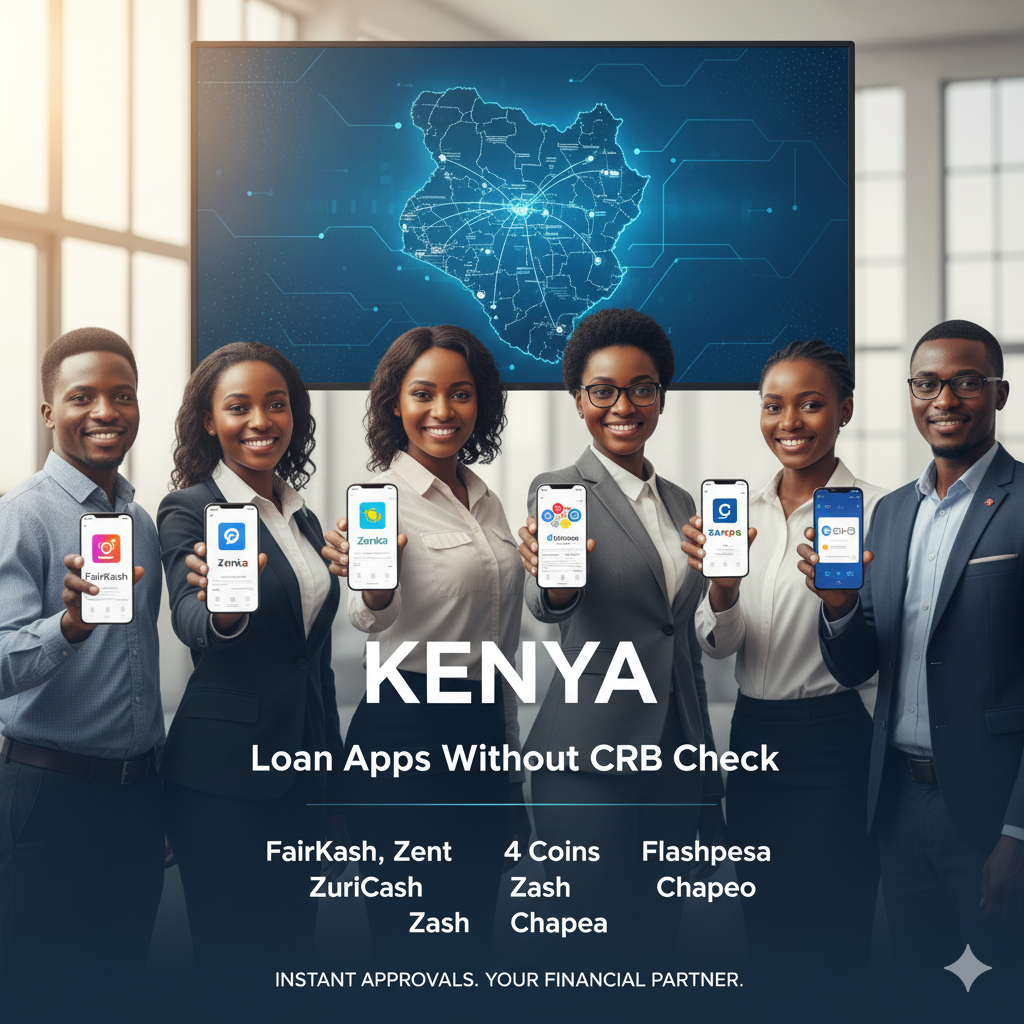
(Note: Many of these are reportedly no longer available, were unregulated, or ceased operations following regulatory intervention.)
Below is a list of apps frequently cited in “no CRB check” claims:
- Fadhili loan app
- Usawa loan app
- Upazi loan app
- Dolax loan app
- Kano loan app
- Saida loan app
- Jazika loan app
- Mokash Loan App
Important caveat: Many of these apps ceased to exist in the Google Play Store (or were removed), or were found to be operating without proper regulation following crackdown by CBK. So although they feature in lists of “no CRB check” apps, they may not be currently active, or their status is uncertain.
Apps That Claim to Give Loans Even If Blacklisted / Ignoring CRB Status
Here are some apps which are widely mentioned in Kenya in the “no CRB check / blacklisted still eligible” category. Note: This list is for information only — you should still verify their licensing, terms, and legitimacy before using.
| Loan App | Range / key details (as available) |
|---|---|
| Flashpesa loan app | (Claimed) no CRB check – small loans quickly |
| Zenka loan app | Widely mentioned in “no CRB check” guides |
| Asapkash loan app | No CRB Check |
| Koro loan app | Legal app with details: First loan from Kes 500, up to Kes 200,000; interest fee 2.45-39% of principal for 61-day loan. |
| ZkPesa loan app | No CRB Check |
| Bayes loan app | No CRB Check |
| Kashbean loan app | No CRB Check |
| ZuriCash loan app | No CRB Check |
| Senti loan app | No CRB Check |
| AdvancePoa loan app | No CRB Check |
| Meta loan app | No CRB Check |
| Zash loan app | No CRB Check |
| 4 Coins loan app | No CRB Check |
| InstarCash loan app | No CRB Check |
| Chapaa loan app | No CRB Check |
| FairKash loan app | No CRB Check |
| Bora Credit loan app | No CRB Check |
Some specific detail (example)
- Koro loan app: “Loan Amount: from KSh 500 to KSh 200,000. Grow with Koro … make loan repayments on time.” (from Google Play store description)
- According to some online guides, some of these apps may claim “we don’t check CRB” but they may still call or access mobile money history or other data.
Why Are These “No CRB Check” Apps Possible?
A few reasons:
- Some lenders may choose to ignore CRB listings (especially for small loan sizes) because they deem the risk manageable, or they rely on other data (mobile payments, salary, etc).
- Some apps lend to “salary workers” (civil servants, parastatals, county government employees) because they view them as lower-risk — so the CRB status becomes less of a barrier.
- Some loans are very small (e.g., under Kes 1,000) so the lender may take a quicker, simpler assessment.
- Some apps may still be unregulated or less regulated, using non-traditional underwriting (which may bypass CRB checks). But this often comes with higher risk for the borrower.
- Regulatory gaps: Though regulation has tightened, there are still many players and many borrowers who borrow from apps that operate in a grey zone.
Important Warnings & Things to Consider
- Just because an app says “no CRB check” does not mean free from risk. You may end up paying high interest or facing aggressive collections.
- Some apps might operate without full licence/approval from CBK; using them can expose you to unfair terms.
- Borrowing when you are already blacklisted may worsen your financial situation if you cannot repay.
- Clearing your name on CRB should be a goal: being blacklisted affects your access to bigger loans, lower interest rates and even job applications or rental agreements in some cases.
- Always check the lender’s licensing, terms & conditions, whether they report to CRB (some do, some don’t) and your own repayment ability.
Final Thoughts
If you are blacklisted by CRB and finding it hard to get credit, the idea of “loan apps without CRB check” is tempting—but you must proceed cautiously. Use these apps only if the terms are transparent, the lender is properly licensed, you understand the costs and repayment schedule, and you are confident you can pay on time.
Simultaneously, work on clearing any negative listings from your CRB record, improving your credit behaviour and building better credit access in the future. Having a good CRB status opens better offers, lower interest rates and more reliable lending.
Disclaimer: This article is for informational purposes only and does not constitute financial advice. Borrow responsibly and consider seeking professional advice.