Kenya’s public service payroll fraud investigation has intensified following a government directive requiring 84 human resources officers to surrender access to the government payroll system and take mandatory leave for 30 days. The officers are linked to departments in the Ministry of Health, Kenya Police Service and Kenya Prisons Service, where investigators are examining suspected irregular salary payments and possible manipulation of payroll records.
The investigation follows the identification of suspected irregularities estimated at KSh 6.2 billion in a public service payroll audit. The findings have raised questions about the management of government employee records, salary payments and the controls used to protect public funds.
Public Service Cabinet Secretary Geoffrey Ruku announced the administrative measures on October 16, 2026, as investigations into the suspected irregularities continued.
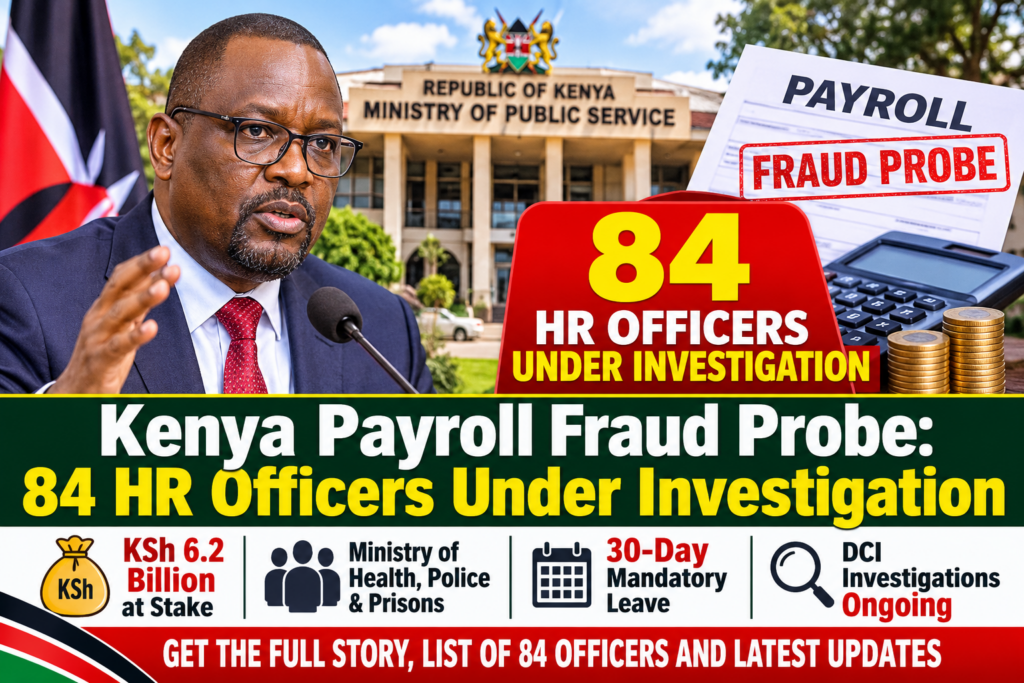
This article explains what is known about the 84 HR officers, the institutions affected, the alleged payroll fraud, the status of the investigation and how to find an officially verified list of the officers.
Important: The 84 officers have been placed under investigation, but this does not mean that every individual has been proven guilty of fraud. A complete, verified list of their names has not been established from the published reports reviewed for this article.
Quick Summary of the Kenya Public Service Payroll Fraud Investigation
| Detail | Information |
|---|---|
| Country | Kenya |
| Investigation | Suspected public service payroll fraud |
| Number of HR officers affected | 84 |
| Estimated amount under investigation | KSh 6.2 billion |
| Public Service Cabinet Secretary | Geoffrey Ruku |
| Investigating agency | Directorate of Criminal Investigations (DCI) |
| Institutions affected | Ministry of Health, Kenya Police Service and Kenya Prisons Service |
| Administrative action | Revocation of payroll access and mandatory 30-day leave |
| Latest reported development | October 19, 2026 |
| Complete list of names | Not verified in the published reports reviewed |
The information above is based on reporting published by Kenyan news organisations concerning the government’s payroll investigation. The KSh 6.2 billion figure relates to the wider suspected payroll irregularities and should not automatically be interpreted as money personally stolen by the 84 officers.
List of the 84 HR Officers in the Kenya Payroll Fraud Investigation
Many Kenyans are searching for the names of the 84 human resources officers reportedly linked to the public service payroll investigation.
However, the published reports reviewed for this article do not provide a complete list containing all 84 names. They identify the affected government institutions and describe the administrative action taken against the officers, but do not establish the identities of all the individuals involved.
For accuracy and fairness, this article does not publish an unverified list of names.
Government Departments Mentioned in the Investigation
The following institutions have been identified in reports about the payroll investigation:
- Ministry of Health: The investigation covers the Department of Medical Services, Public Health and Professional Standards.
- Kenya Police Service: Payroll records and transactions involving the police service are among those being examined.
- Kenya Prisons Service: Investigators are examining suspected irregular payments and payroll transactions involving prison officers.
The government has directed the withdrawal of payroll access rights for the affected HR officers and the deployment of replacement personnel to maintain normal payroll operations.
Where can Kenyans find the official list of the 84 officers?
The most reliable source would be an official government statement, a published investigative document or another verifiable public record that identifies the officers. Readers should check announcements from the Ministry responsible for Public Service and the Directorate of Criminal Investigations.
Until such a document is available, social media posts circulating lists of names should not be treated as verified evidence.
What Happened to the 84 HR Officers?
On October 16, 2026, Public Service Cabinet Secretary Geoffrey Ruku ordered 84 human resources officers to take mandatory 30-day leave and directed that their access to government payroll systems be revoked.
The action followed investigations by the Directorate of Criminal Investigations into suspected irregular transactions affecting government payrolls.
According to reports published by The Star and The Standard, the officers were drawn from the Ministry of Health, Kenya Police Service and Kenya Prisons Service.
The administrative measures are intended to allow forensic investigations to proceed while preventing the affected officers from making further changes to payroll records during the review.
The government has also arranged for other human resources officers to take over payroll management in the affected departments.
The measures do not, by themselves, establish criminal guilt. Investigators must establish the facts and determine the responsibility, if any, of individual officers.
What Is the KSh 6.2 Billion Payroll Fraud Case About?
The investigation follows a public service payroll audit that identified substantial irregularities in government salary records and payments.
On July 8, 2026, Public Service Cabinet Secretary Geoffrey Ruku handed payroll audit findings to the Directorate of Criminal Investigations for further investigation.
The audit raised concerns about payroll data integrity, system access controls, employee records and potentially irregular payments.
Reported findings included:
- Employees recorded as having been posted before their official dates of recruitment.
- Inconsistent employee identification and personal information.
- Multiple or shared bank account details associated with payroll records.
- Salary and arrears payments requiring further verification.
- Payroll records that had been edited without adequate audit trails.
- Weaknesses in system security and monitoring.
These findings suggest that the investigation involves more than isolated salary errors. Investigators are examining whether weaknesses in government payroll administration were exploited to facilitate irregular payments.
However, a payroll irregularity is not automatically proof of deliberate fraud. Some discrepancies can result from administrative errors, outdated records or system integration problems. The purpose of the investigation is to establish the facts behind the identified transactions.
How Was the Suspected Payroll Fraud Discovered?
The investigation followed a review of government payroll systems and the handover of audit findings to the DCI.
The audit examined aspects of the Human Resource Information System–Kenya, commonly referred to as HRIS-K, including payroll integrity, system integration, access controls, cybersecurity safeguards and the management of employee records.
The findings raised concerns about the accuracy of employee information and the controls governing payroll changes.
Investigators are now examining the transactions and records to establish how the suspected irregularities occurred, who was responsible for particular actions and whether public funds were improperly paid or diverted.
The withdrawal of payroll access rights is an administrative safeguard intended to protect the integrity of the system while investigations continue.
Why Were the 84 HR Officers Sent on Mandatory Leave?
The government ordered the affected officers to take mandatory leave for 30 days as part of the ongoing investigation.
The measure serves several purposes:
1. Protecting payroll records
Restricting access can help prevent unauthorised changes to employee details, salary records and payment instructions while investigators examine the system.
2. Supporting forensic investigations
Investigators can review transaction histories, system logs and supporting documents without the affected officers continuing to manage the relevant payroll functions.
3. Maintaining payroll operations
Replacement HR officers have been assigned to take over the affected responsibilities so that legitimate government employees can continue receiving their salaries.
4. Establishing individual responsibility
Investigators can examine the actions of individual users and determine whether particular transactions were authorised, erroneous or potentially fraudulent.
Mandatory leave is not the same as a criminal conviction. Any decision to prosecute or discipline an individual must follow the applicable legal and administrative procedures.
Which Government Institutions Are Affected?
1. Ministry of Health
The Ministry of Health is among the institutions mentioned in reports about the suspected payroll irregularities.
The investigation includes the Department of Medical Services, Public Health and Professional Standards.
The review is intended to establish whether payroll records and payments in the affected departments were properly authorised and supported by valid employment information.
2. Kenya Police Service
Payroll records associated with the Kenya Police Service are also being examined.
Investigators are looking into suspected irregular transactions and the processes used to manage employee information and salary payments.
The investigation does not mean that every police officer or employee in the service is implicated.
3. Kenya Prisons Service
The Kenya Prisons Service is another institution affected by the investigation.
Previous reporting has described suspected irregular allowance payments involving prison officers. The government is examining the relevant transactions and the circumstances under which they were processed.
The investigation is expected to establish whether the payments were legitimate, improperly authorised or connected to wider payroll manipulation.
What Is the Role of the Directorate of Criminal Investigations?
The Directorate of Criminal Investigations is responsible for investigating suspected criminal conduct and gathering evidence that may support prosecution where appropriate.
In the payroll case, the DCI is examining the audit findings and supporting documentation provided by the government.
The investigative process may involve:
- Reviewing payroll transactions and employee records.
- Examining system access histories and transaction logs.
- Verifying recruitment and appointment documents.
- Tracing suspicious salary and allowance payments.
- Recording statements from relevant individuals.
- Establishing who authorised or processed particular transactions.
- Referring cases for prosecution where sufficient evidence exists.
The findings of an audit can identify suspicious transactions, but criminal liability must be established through the appropriate legal process.
What Happens After the 30-Day Mandatory Leave?
The administrative leave is intended to provide time for investigators and government officials to examine the suspected irregularities.
Depending on the evidence and the applicable procedures, possible next steps may include:
- Further interviews and forensic examination of payroll records.
- Disciplinary proceedings where there is evidence of misconduct.
- Arrests and criminal charges where investigators establish a lawful basis.
- Recovery proceedings for public funds shown to have been improperly paid.
- Improvements to payroll access controls and employee verification systems.
- Further administrative action against individuals found responsible.
The outcome will depend on the evidence gathered and the decisions of the relevant investigative, prosecutorial and disciplinary authorities.
The 30-day leave period should not be interpreted as a deadline by which every investigation or court case must be completed.
Will Government Employees Continue Receiving Their Salaries?
The government has directed replacement human resources officers to take over payroll management in the affected departments.
This arrangement is intended to maintain normal payroll operations while investigations continue.
The action against the 84 HR officers does not mean that all employees in the affected institutions have been accused of wrongdoing or that every salary payment has been suspended.
Individual employees who have concerns about their salary payments should use the official HR and payroll channels within their respective institutions.
How Could Payroll Fraud Affect Kenyan Taxpayers?
Public service payrolls are funded through public resources. When money is paid without proper authorisation or to ineligible beneficiaries, it can reduce the resources available for essential government services.
Potential consequences include:
- Increased pressure on public finances.
- Reduced funds available for legitimate government expenditure.
- Loss of confidence in public institutions.
- Additional costs associated with investigations and recovery.
- Delays caused by payroll verification exercises.
- The need for stronger internal controls and accountability.
Effective payroll management requires accurate employee records, secure system access, clear approval procedures and regular reconciliation of salary payments against verified employment information.
How Can the Government Prevent Future Payroll Fraud?
The investigation has highlighted the importance of stronger safeguards across public service payroll systems.
Strengthen employee verification
Government departments should regularly verify employee identities, appointment letters, deployment records and employment status.
Improve payroll access controls
Access should be granted according to an employee’s responsibilities, with additional approval requirements for sensitive changes.
Maintain complete audit trails
Payroll systems should record who made a change, when it occurred and whether the transaction received the required authorisation.
Reconcile bank account information
Payroll administrators should investigate unexplained shared accounts, duplicate payment instructions and inconsistent beneficiary details.
Conduct regular payroll audits
Independent reviews can help identify unusual transactions and data discrepancies before they result in substantial losses.
Protect whistleblowers
Employees who report suspected wrongdoing should have appropriate channels for raising concerns without facing unlawful retaliation.
Improve cybersecurity
Strong authentication, continuous monitoring and timely security assessments can help reduce opportunities for unauthorised payroll changes.
Frequently Asked Questions About the 84 HR Officers and Kenya Payroll Fraud
1. Who are the 84 HR officers linked to payroll fraud in Kenya?
They are human resources officers from the Ministry of Health, Kenya Police Service and Kenya Prisons Service whose payroll access rights were revoked and who were directed to take mandatory 30-day leave during investigations into suspected irregularities.
A complete, verified list of their names has not been established from the published reports reviewed for this article.
2. Has the government released the full list of the 84 officers?
The reports reviewed describe the administrative action and the affected institutions but do not provide a complete list of all 84 officers by name. Readers should rely on official records rather than unverified lists circulating online.
3. How much money is involved in the Kenya payroll fraud investigation?
The wider payroll investigation has been associated with suspected irregularities estimated at KSh 6.2 billion. This figure should not be interpreted as the amount personally stolen by the 84 officers or as a final determination of recoverable losses.
4. Which government departments are involved?
The reported investigation covers the Ministry of Health, Kenya Police Service and Kenya Prisons Service.
5. Who ordered the 84 HR officers to take leave?
Public Service Cabinet Secretary Geoffrey Ruku announced the administrative measures on October 16, 2026.
6. How long will the officers remain on mandatory leave?
The directive provides for a 30-day mandatory leave period. The duration of the leave should not be confused with the time required to complete all criminal or disciplinary investigations.
7. Have all 84 officers been found guilty?
No. The reported action is connected to an ongoing investigation. An administrative measure or allegation is not equivalent to a criminal conviction.
8. Will the officers be arrested?
Arrests may follow if investigators establish sufficient grounds and the applicable legal requirements are met. The outcome for any particular individual should not be assumed before official confirmation.
9. Will the investigation affect public service salary payments?
Replacement HR officers have been assigned to manage payroll functions in the affected departments. The measures are intended to maintain payroll operations while the investigation proceeds.
10. Where can I get verified updates about the case?
Check official announcements from the Ministry responsible for Public Service, the Directorate of Criminal Investigations and other relevant government authorities. Reputable Kenyan news organisations can also provide updates, but individual names should be checked against reliable documentary evidence.
Conclusion
The investigation involving 84 HR officers represents a significant development in Kenya’s efforts to examine suspected irregularities in government payroll management.
The affected officers have had their payroll system access revoked and have been directed to take mandatory 30-day leave while investigators examine transactions involving the Ministry of Health, Kenya Police Service and Kenya Prisons Service.
The wider investigation concerns suspected payroll irregularities estimated at KSh 6.2 billion, although the amount attributable to individual transactions or persons must be established through evidence.