Back arthritis can cause persistent pain, stiffness, reduced mobility, and difficulties performing everyday activities. For Kenyans living with severe back pain, the cost of medical consultations, diagnostic scans, medication, physiotherapy, injections, and possible surgery can create a significant financial burden.
Fortunately, several healthcare financing options may help patients access treatment without paying the entire bill upfront. These include the Social Health Authority (SHA), medical insurance, hospital payment arrangements, employer medical benefits, savings groups, and specialised healthcare financing providers.
In this guide, we explain what back arthritis is, the available treatment options, when surgery may be necessary, and how to explore medical loans and other healthcare financing options in Kenya in 2026.
We also discuss how to check eligibility, understand repayment obligations, and avoid misleading medical loan offers.
Important: A medical loan is a form of borrowing, not a medical treatment. Before taking one, patients should establish the likely treatment cost, check available insurance benefits, and compare the total cost of borrowing.
What Is Back Arthritis?
Back arthritis refers to arthritic conditions affecting the joints and structures of the spine. One common form is spinal osteoarthritis, which occurs when the protective cartilage in joints gradually wears down.
The condition may affect the small joints connecting the vertebrae, known as facet joints. Arthritis can also occur alongside other spinal problems, including degenerative disc disease and spinal stenosis.
Back arthritis is more common as people age, although other factors can contribute to spinal joint problems.
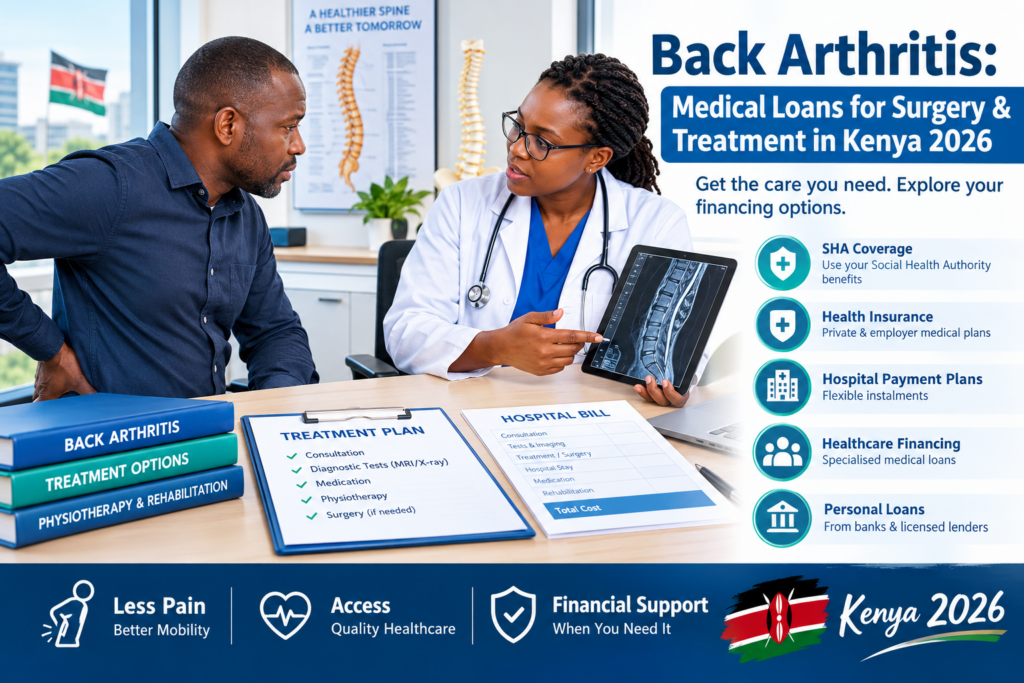
Back Arthritis Loans Kenya
Common Symptoms of Back Arthritis
Symptoms vary depending on the affected part of the spine and the severity of the condition.
Common symptoms include:
- Persistent lower back or neck pain.
- Stiffness, particularly after waking up or remaining inactive.
- Pain that becomes worse after certain activities.
- Reduced flexibility when bending or twisting.
- Discomfort when standing or walking for extended periods.
- Pain that may spread into the buttocks or legs.
- Numbness, tingling, or weakness when nerves are affected by an associated spinal condition.
Not every person with arthritis experiences severe symptoms. Some people have changes visible on imaging scans without significant pain.
A qualified healthcare professional should assess persistent or worsening back pain before treatment decisions are made.
When Should You Seek Medical Attention?
Arrange a medical assessment if back pain persists, interferes with normal activities, or repeatedly returns.
Seek emergency medical attention if back pain occurs alongside new loss of bladder or bowel control, numbness around the groin or saddle area, or rapidly worsening leg weakness. These symptoms can indicate serious nerve compression.
Do not delay urgent medical assessment while looking for a loan or waiting for financing approval.
How Much Does Back Arthritis Treatment Cost in Kenya in 2026?
The cost of treating back arthritis depends on the diagnosis, hospital, specialist, investigations, treatment plan, and whether surgery is required.
Patients may need to budget for several services rather than one consultation.
| Medical service | What the expense may cover |
|---|---|
| Initial consultation | Assessment by a doctor or specialist |
| Diagnostic imaging | X-rays, MRI scans, or other investigations when indicated |
| Medication | Prescribed pain-relief or other appropriate medicines |
| Physiotherapy | Supervised exercises, mobility work, and rehabilitation |
| Specialist treatment | Further assessment or selected procedures |
| Pain-management procedures | Injections or other interventions when medically appropriate |
| Surgery | Surgeon, theatre, anaesthesia, implants where required, and hospital stay |
| Post-operative care | Follow-up appointments, medication, and rehabilitation |
There is no single price for back arthritis surgery in Kenya. The total cost may vary substantially depending on the operation and the hospital providing treatment.
For example, a patient requiring conservative treatment and physiotherapy will generally have different expenses from someone requiring spinal decompression or spinal fusion.
Before borrowing, request a written treatment estimate from the hospital. Ask whether the estimate includes investigations, professional fees, medicines, implants, hospital accommodation, and rehabilitation.
Also ask what happens if complications or additional treatment increase the final bill.
Does Back Arthritis Require Surgery?
No. Most people with back arthritis do not automatically require surgery.
Treatment usually begins with conservative approaches, depending on the diagnosis and the patient’s symptoms.
1. Medication
A doctor may recommend appropriate medication to help manage pain and inflammation.
The correct choice depends on a patient’s age, medical history, other medicines, and potential side effects.
Medication can reduce symptoms, but it does not necessarily reverse the underlying joint changes.
2. Physiotherapy
Physiotherapy may help improve movement, strength, flexibility, and everyday function.
A physiotherapist can develop an individualised programme based on the patient’s condition and physical abilities.
The number of sessions required varies. Patients should ask for a treatment plan and an estimate of the likely cost.
3. Lifestyle and Activity Adjustments
Depending on the diagnosis, a clinician may recommend maintaining appropriate physical activity, modifying painful activities, and improving posture or movement techniques.
Prolonged inactivity may contribute to reduced strength and mobility, so patients should seek advice before significantly restricting their activities.
4. Pain-Management Procedures
Some patients may be offered selected injections or other specialist procedures when appropriate.
These treatments are not suitable for everyone, and their benefits vary depending on the underlying condition.
5. Back Surgery
Surgery may be considered when a specific spinal problem is causing severe symptoms, particularly where there is significant nerve compression or other structural disease.
Possible procedures include:
- Spinal decompression: Surgery intended to relieve pressure on affected nerves.
- Laminectomy: Removal of part of a vertebra in selected cases to create more space for nerves.
- Spinal fusion: Joining selected vertebrae to improve stability in appropriate cases.
The correct procedure depends on the diagnosis, examination findings, imaging results, and specialist assessment.
Spinal surgery carries risks and may require substantial rehabilitation. Patients should discuss expected benefits, alternatives, complications, recovery time, and total costs with their specialist.
Medical Loans for Back Arthritis Treatment in Kenya 2026
If treatment costs exceed available savings or insurance benefits, patients may explore healthcare financing.
However, a conventional personal loan is not the same as a dedicated medical financing arrangement. Some options pay a healthcare provider directly, while others provide funds that the borrower must use and repay according to the loan agreement.
The following options are worth investigating.
1. Social Health Authority (SHA)
The Social Health Authority is an important starting point for Kenyans seeking assistance with eligible healthcare expenses.
Under Kenya’s current healthcare financing framework, the Social Health Insurance Fund provides benefits for covered services, subject to applicable rules, tariffs, eligibility requirements, and any required authorisation.
The treatment available to a particular patient depends on the relevant benefit package and the facility’s participation in the programme.
For someone with back arthritis, the first step is to ask the treating hospital whether the required consultations, investigations, hospital treatment, or surgery are covered under the patient’s applicable SHA benefits.
Do not assume that every MRI scan, physiotherapy session, injection, or spinal operation is automatically covered.
How to Check SHA Medical Coverage
- Confirm your SHA registration and contribution status.
- Visit an appropriate healthcare facility participating in the relevant SHA programme.
- Obtain a clinical assessment and recommended treatment plan.
- Ask the facility to check the applicable benefits and authorisation requirements.
- Request a written breakdown of any expenses that may remain payable by the patient.
Official information is available through the Social Health Authority website.
Why consider SHA first?
If eligible services are covered, the amount you need to pay yourself may be reduced. This can help you avoid borrowing more than necessary.
2. Access Health: Healthcare Financing
Access Health advertises healthcare financing intended to help individuals and families manage medical expenses.
Its published information describes a model in which members make monthly contributions, build a healthcare preparedness balance, and may qualify for medical bill financing with repayment over time.
The provider advertises plans starting at KSh 300 per month. However, that advertised contribution should not be interpreted as a guaranteed loan approval, a guaranteed surgery benefit, or a promise that every treatment cost will be paid.
Before relying on this option for back arthritis treatment, contact the provider to confirm its current eligibility rules and financing terms.
Questions to Ask Access Health
- Can the programme finance treatment for an existing back arthritis condition?
- Is there a waiting period or a requirement to build a contribution history?
- Does it cover spinal surgery, MRI scans, physiotherapy, or specialist consultations?
- What is the maximum amount available to an eligible patient?
- Does the provider pay the hospital directly?
- What interest, fees, penalties, or other charges apply?
- How long is the repayment period?
- What happens if the treatment costs more than the approved amount?
You can review the provider’s published services and contact details on the official Access Health website.
Important: Confirm all terms in writing before making contributions or relying on financing for a planned operation.
3. Hospital Payment Plans
Some hospitals and healthcare providers may offer payment arrangements, credit facilities, or agreements with medical financiers.
Availability depends on the facility, the treatment, the patient’s circumstances, and the provider’s policies.
Ask the hospital’s billing or credit-control department whether it offers an instalment arrangement for eligible treatment.
Questions to ask include:
- Is a deposit required?
- Can the hospital bill an insurer or eligible SHA programme?
- Is instalment payment available for planned spinal surgery?
- What are the repayment dates and total charges?
- Must the patient obtain financing from an approved external provider?
- What costs must be paid before treatment or discharge?
Request a written agreement and compare the total amount payable with other options.
A hospital payment arrangement may be more suitable than a general-purpose personal loan, but this depends on the terms offered.
4. Employer Medical Benefits
Employees should check whether their employer provides medical insurance, a staff medical fund, or an employee assistance programme.
Some employers offer benefits for specialist consultations, diagnostic tests, hospital admissions, and surgery, subject to policy limits and exclusions.
Before taking a medical loan, contact your human resources department or insurance administrator.
Ask whether the policy covers the diagnosed condition, whether pre-authorisation is necessary, and whether the selected hospital is within the insurer’s network.
Also establish the patient’s co-payment, annual limit, and any exclusions that may apply.
5. Private Medical Insurance
Private health insurance may help meet eligible treatment expenses, depending on the policy.
Coverage differs between insurers and plans. Some policies impose waiting periods, annual limits, exclusions, or special approval requirements for particular procedures.
Patients should not assume that a newly purchased policy will immediately cover an existing condition or a planned operation.
Ask the insurer for written confirmation of coverage before committing to surgery.
If the policy does not cover the full bill, establish the remaining amount before considering additional borrowing.
6. Personal Loans From Financial Institutions
A patient may consider a personal loan from a bank or another appropriately regulated lender if other financing options are insufficient.
Unlike dedicated healthcare financing, a general-purpose personal loan may provide money that the borrower can use to meet medical expenses.
However, approval is not guaranteed. Lenders may assess income, existing debt, credit history, employment, and repayment capacity.
Before signing an agreement, confirm:
- The amount approved.
- The interest rate and whether it is fixed or variable.
- Processing fees and other charges.
- The total repayment amount.
- The monthly instalment.
- The repayment period.
- Late-payment consequences.
- Any collateral or guarantor requirements.
Avoid borrowing more than the amount needed for the confirmed treatment expenses.
A longer repayment period may reduce the monthly instalment while increasing the total amount paid.
Comparison of Medical Financing Options in Kenya
| Financing option | Potential benefit | Important consideration |
|---|---|---|
| SHA | May cover eligible treatment under applicable benefits | Coverage and authorisation rules apply |
| Access Health | Advertises healthcare financing and flexible repayment | Verify eligibility, existing-condition rules, and total charges |
| Hospital payment plan | May allow agreed instalments | Availability and terms vary by facility |
| Employer medical scheme | May reduce eligible treatment expenses | Check limits, exclusions, and hospital network |
| Private medical insurance | May cover eligible specialist care and surgery | Waiting periods and policy conditions may apply |
| Personal loan | May provide funds for uncovered expenses | Interest, fees, and repayment obligations apply |
| Family or savings-group assistance | May reduce the amount borrowed | Agree clearly on contributions and repayment expectations |
No option guarantees approval or full coverage of back arthritis treatment. The most appropriate choice depends on the patient’s clinical needs, finances, eligibility, and the terms available.
How to Apply for Medical Financing for Back Surgery in Kenya
If a specialist recommends surgery, use the following steps to organise your treatment and financing.
Step 1: Obtain a Medical Diagnosis
Visit a qualified healthcare professional for an assessment.
The doctor may recommend imaging or other investigations depending on your symptoms and examination.
Do not borrow for a particular operation before confirming that it is medically appropriate.
Step 2: Obtain a Written Treatment Estimate
Ask the hospital for an itemised quotation covering the planned procedure and associated expenses.
Check whether the estimate includes:
- Specialist consultation.
- Diagnostic tests.
- Surgeon’s fees.
- Anaesthesia.
- Theatre charges.
- Hospital accommodation.
- Medicines and supplies.
- Implants or other surgical materials, if required.
- Post-operative consultations.
- Physiotherapy and rehabilitation.
The quotation should also explain which costs may change.
Step 3: Check SHA and Insurance Benefits
Ask the hospital and insurer or relevant financing administrator to determine what portion of the bill may be covered.
Request confirmation of pre-authorisation requirements and any patient contribution.
Step 4: Calculate the Funding Gap
Subtract the confirmed insurance or SHA contribution and any available savings from the expected treatment cost.
For example, suppose a hospital provides an illustrative treatment estimate of KSh 200,000.
If confirmed coverage and available savings total KSh 120,000, the remaining funding gap would be KSh 80,000.
These figures are examples only, not a quotation for spinal surgery in Kenya.
The aim is to avoid borrowing for expenses that are already covered.
Step 5: Compare Financing Offers
Compare at least two suitable options where possible.
Focus on the total amount repayable, monthly instalments, fees, and the consequences of missing a payment.
Do not choose a loan simply because it advertises instant approval or a large limit.
Step 6: Prepare the Required Documents
Depending on the provider, you may be asked for:
- National identification or another accepted identity document.
- Contact information.
- Proof of income or bank statements.
- Medical reports or a treatment quotation.
- Insurance or SHA details.
- Information about existing financial obligations.
Submit sensitive medical and financial information only through verified channels.
Step 7: Read the Agreement Before Accepting
Check the interest rate, all fees, repayment dates, penalties, and applicable terms.
Ensure the instalments are affordable after accounting for food, housing, transport, family responsibilities, and other essential expenses.
Step 8: Confirm Payment Arrangements With the Hospital
If the lender pays the hospital directly, obtain confirmation of the approved amount and payment process.
If the funds are paid to you, establish the conditions for receiving and using the money.
Keep copies of the quotation, financing agreement, receipts, and payment confirmations.
How Much Should You Borrow for Back Arthritis Treatment?
The appropriate amount depends on the confirmed funding gap and your ability to repay.
Consider this illustrative example:
| Item | Amount |
|---|---|
| Estimated treatment bill | KSh 150,000 |
| Confirmed insurance or SHA contribution | KSh 70,000 |
| Available savings | KSh 30,000 |
| Remaining funding gap | KSh 50,000 |
In this example, the funding gap is KSh 50,000 before any additional costs or financing charges.
A lender may approve a different amount, and the final treatment bill may change. Confirm the figures with the hospital and relevant financing providers before proceeding.
Remember: The amount you qualify to borrow is not necessarily the amount you can comfortably repay.
How to Avoid Medical Loan Scams in Kenya
People facing expensive medical bills may be vulnerable to misleading loan offers.
Be cautious when an unknown lender promises guaranteed financing for spinal surgery or demands payment before releasing a loan.
Watch out for these warning signs:
- Requests for an upfront payment to unlock a supposedly approved loan.
- Promises of guaranteed approval regardless of income or eligibility.
- Unclear interest rates or unexplained charges.
- Pressure to accept an offer immediately.
- Requests to send money to a personal mobile-money number without verifiable documentation.
- Websites or messages that impersonate hospitals, insurers, banks, or healthcare financing providers.
- Requests for PINs, passwords, or one-time security codes.
Before accepting an offer, independently verify the provider’s identity and applicable regulatory status.
Do not assume that an online advertisement, social-media page, or professional-looking website proves that a lender is legitimate.
Never share your mobile-money PIN or banking password with a lender.
Can SHA Cover Back Arthritis Surgery in Kenya?
SHA may cover eligible healthcare services according to the applicable benefit package and authorisation rules.
However, coverage for a particular spinal procedure cannot be assumed without checking the patient’s circumstances and the relevant service requirements.
If a specialist recommends surgery, ask the hospital to confirm:
- Whether the facility participates in the relevant SHA programme.
- Whether the procedure is an eligible benefit.
- Whether the patient meets the applicable eligibility requirements.
- Whether prior authorisation or referral documentation is necessary.
- Whether implants, medicines, rehabilitation, and follow-up appointments are included.
- Whether any patient contribution or additional charge may apply.
The hospital should explain any uncovered costs before a planned procedure wherever possible.
For official programme information, consult the Social Health Authority.
What If You Cannot Afford Back Arthritis Treatment?
If you cannot afford the recommended treatment, speak to the hospital’s social-work department, patient-welfare office, billing team, or financial counselling service, where available.
Ask whether the facility has a patient-assistance programme, charitable support, an instalment arrangement, or referrals to organisations that help eligible patients.
You can also ask the treating clinician whether there are medically appropriate alternatives that cost less or can be delivered in stages.
Do not postpone urgent medical assessment while searching for financial assistance.
If you are a young person who needs medical care, ask a trusted adult or caregiver to help you contact the hospital and explore appropriate payment arrangements.
Frequently Asked Questions About Medical Loans for Back Arthritis in Kenya
1. Can I get a medical loan for back arthritis surgery in Kenya in 2026?
Potentially, yes. Depending on eligibility, you may be able to explore healthcare financing, a hospital payment plan, employer medical benefits, or a personal loan. Approval and the amount available depend on the provider’s terms and your circumstances.
2. Which is the best medical loan provider in Kenya?
There is no single best provider for every patient. Compare the total repayment cost, eligibility requirements, treatment coverage, payment arrangements, and applicable regulatory status before choosing.
3. Does SHA cover back arthritis treatment?
SHA may cover eligible healthcare services under its applicable benefit packages. Ask your treating facility to confirm coverage for your specific consultation, investigation, procedure, or surgery.
4. Can I get financing for an MRI scan?
Some healthcare financing arrangements or insurance policies may cover eligible diagnostic imaging. Confirm whether the specific MRI scan is covered, whether pre-authorisation is required, and what you must pay yourself.
5. Can a medical loan pay for physiotherapy?
Depending on the provider, financing may be available for eligible physiotherapy expenses. Obtain a treatment plan and quotation, then confirm the provider’s coverage and repayment conditions.
6. How much does back arthritis surgery cost in Kenya?
Costs vary according to the diagnosis, procedure, hospital, professional fees, implants, length of admission, and rehabilitation needs. Request an itemised quotation from the treating hospital instead of relying on a general online estimate.
7. Can I borrow money for back arthritis treatment without insurance?
Some financing providers may consider eligible applicants without private medical insurance. However, approval is not guaranteed, and the patient remains responsible for costs not covered by another funding source.
8. Is surgery always necessary for back arthritis?
No. Many patients can manage symptoms through appropriate conservative treatment, including medication, physiotherapy, and activity adjustments. Surgery is considered when clinically indicated.
9. What documents are required to apply for a medical loan?
Requirements vary by provider. Common requests may include identification, income information, a medical quotation, contact details, and relevant insurance information.
10. What should I do if I cannot repay a medical loan?
Contact the lender promptly and ask whether a revised payment arrangement is available. Review the agreement and seek appropriate financial guidance rather than taking another expensive loan to repay the first.
Final Thoughts: Getting Affordable Back Arthritis Treatment in Kenya
Back arthritis can affect mobility, employment, family responsibilities, and quality of life. Although treatment expenses can be challenging, patients have several possible routes to explore before taking on debt.
Start with a proper medical assessment, obtain a written treatment quotation, and check SHA and insurance benefits. Then investigate hospital payment plans, employer medical benefits, specialised healthcare financing, or an appropriately regulated personal loan if a funding gap remains.
Before borrowing, compare the full repayment cost and ensure that the instalments are manageable.
Most importantly, do not delay urgent medical care while searching for financing, and do not assume that an advertised medical loan or healthcare plan guarantees approval or full payment of your treatment bill.
Disclaimer: This article provides general educational information and is not a substitute for professional medical, legal, or financial advice. Treatment decisions should be made with a qualified healthcare professional. Medical financing availability, eligibility, costs, and coverage are subject to the provider’s current terms and applicable regulations.