Kenya secures crucial World Bank funding as Treasury races to meet reform targets amid a widening budget deficit and growing economic pressures.
Kenya to Receive KSh 96.6 Billion World Bank Loan in Major Fiscal Boost
Kenya is expected to receive a KSh 96.6 billion ($750 million) Development Policy Operation (DPO) loan from the World Bank before the end of June 2026, providing a significant boost to the government’s fiscal position ahead of the new financial year.
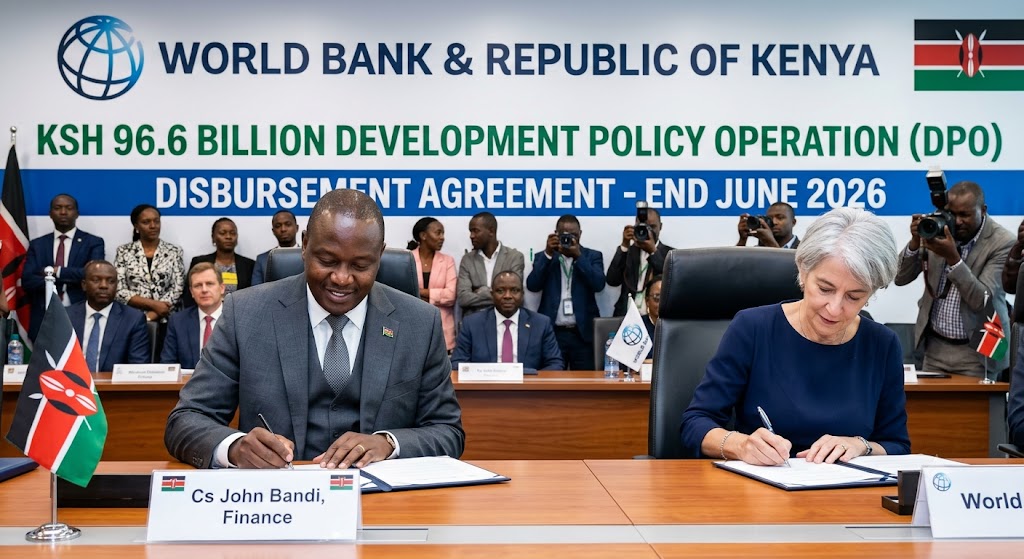
The funding comes at a pivotal moment for the Kenyan economy, as the government seeks to manage a projected KSh 1.1 trillion budget deficit in the 2026/27 fiscal year while maintaining macroeconomic stability amid global economic uncertainties.
Unlike project-specific financing, the DPO facility will be disbursed directly into government accounts as budget support, enabling the National Treasury to strengthen public finances, reduce reliance on expensive domestic borrowing, and support critical government operations.
World Bank Conditions Kenya Must Meet Before Disbursement
The World Bank’s approval of the loan is tied to key policy and institutional reforms aimed at strengthening governance, social protection, and climate resilience.
1. Strengthening Social Protection Through the Enhanced Single Registry
One of the key requirements involves the implementation of regulations governing Kenya’s social assistance programs.
The government has been transitioning to an Enhanced Single Registry, a centralized system designed to improve the identification and verification of beneficiaries receiving cash transfers, including older persons, orphans, vulnerable children, and persons living with disabilities.
The reforms are intended to improve transparency, reduce fraud, and ensure that public funds reach the most deserving households.
2. Establishing a Framework for Sustainability-Linked Bonds
Kenya has also been required to develop a regulatory framework for Sustainability-Linked Bonds (SLBs), an increasingly popular financing instrument in global capital markets.
SLBs allow governments and institutions to raise capital while linking borrowing costs to measurable environmental, social, and governance (ESG) performance targets.
The move is expected to position Kenya as a regional leader in sustainable finance and attract climate-focused investors seeking exposure to emerging markets.
3. Providing Legal Backing for Kenya’s 30% Tree Cover Target
Another critical condition is the establishment of a legal framework supporting Kenya’s commitment to increase national tree cover to 30 percent by 2032.
The policy aligns with the country’s broader climate action agenda and supports global efforts to combat deforestation, enhance biodiversity, and strengthen environmental resilience.
Why the Funding Matters for Kenya’s Economy
The expected disbursement arrives as Kenya prepares to implement a KSh 4.82 trillion national budget for the 2026/27 financial year.
Economic analysts say the World Bank funding could ease pressure on government finances in several ways:
Reducing Pressure on Domestic Borrowing
By accessing concessional external financing, the government can reduce its dependence on local debt markets, helping to lower competition for credit between the public and private sectors.
Supporting Private Sector Lending
Reduced government borrowing could free up liquidity within the banking sector, allowing commercial banks to extend more credit to businesses and households.
Private sector credit growth has already shown signs of improvement in 2026, and additional fiscal support could accelerate that trend.
Strengthening Kenya’s External Position
The loan will inject fresh foreign currency into the economy, helping to reinforce Kenya’s external reserves at a time when global energy prices and geopolitical tensions continue to pose risks to import-dependent economies.
Key Economic Indicators
| Economic Indicator | Status (June 2026) |
|---|---|
| Total National Budget (2026/27) | KSh 4.82 Trillion |
| Projected Budget Deficit | KSh 1.1 Trillion |
| Foreign Exchange Reserves | $13.2 Billion |
| Import Cover | 5.6 Months |
| Projected GDP Growth | 4.9% – 5.5% |
Potential Impact on the Kenyan Shilling and Inflation
Economists expect the World Bank disbursement to have a positive impact on investor confidence and Kenya’s foreign exchange position.
The additional $750 million is likely to strengthen the Central Bank of Kenya’s reserve buffers, helping stabilize the Kenyan shilling against major international currencies.
A stronger external reserve position could also cushion the economy against imported inflation pressures, particularly those arising from elevated global fuel and commodity prices.
Although inflation has edged higher in recent months, policymakers remain optimistic that continued fiscal discipline and support from development partners will help keep inflation within the government’s medium-term target range.
Growing Shift Toward Reform-Based Financing
The World Bank’s conditions highlight a broader trend in international development financing, where access to funding is increasingly linked to governance reforms, social accountability measures, and climate-related commitments.
For Kenya, successful completion of these reforms not only unlocks immediate financial support but also sends a strong signal to investors and international markets about the country’s commitment to fiscal responsibility and sustainable economic growth.
Outlook
If disbursed as expected before June 30, the KSh 96.6 billion World Bank facility will provide critical fiscal breathing room for the National Treasury as it navigates one of the region’s largest public budgets.
The funding is expected to support economic stability, strengthen investor confidence, and help Kenya balance development priorities with long-term debt sustainability goals.
As Kenya advances its fiscal and environmental reform agenda, the World Bank loan could become one of the most consequential sources of budget support for the country’s 2026/27 financial year.