Access to money when you need it can make a big difference—whether you’re running a small business, managing farm inputs, or handling family expenses. In Zambia today, flexible loans are becoming one of the easiest ways to borrow without the stress of strict bank conditions.
This guide breaks things down simply so you can choose what works best for your situation.
1. What Is a Flexible Loan (In Simple Terms)?
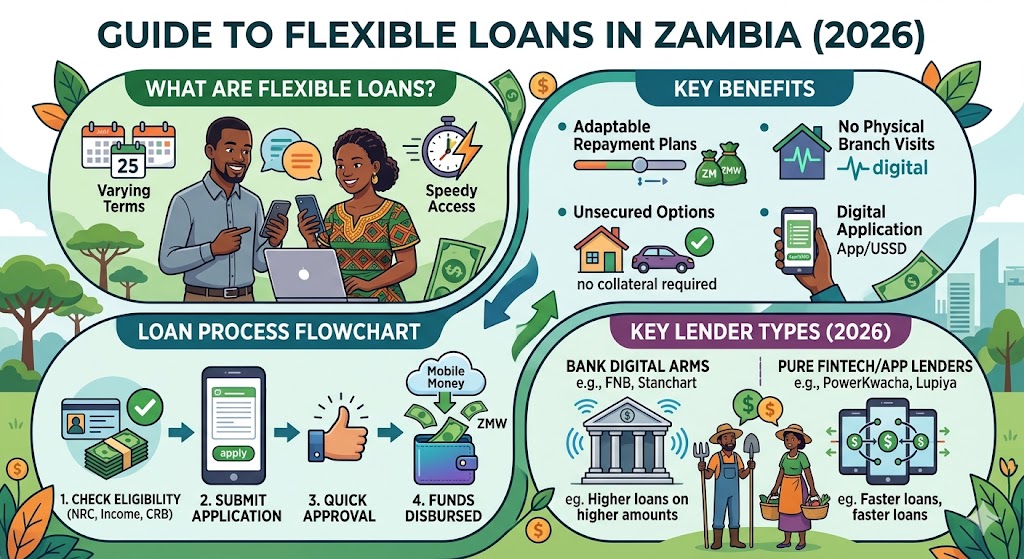
A flexible loan is just a loan that gives you more control. Instead of fixed, rigid rules, you can adjust things to suit your income.
Here’s what that means in real life:
- You choose how long to repay – maybe 3 months if it’s urgent, or up to 2–4 years for bigger needs
- You can apply using your phone – no need to always visit a bank branch
- No collateral for many loans – you don’t need land, a car, or a house
👉 This is especially helpful if you’re self-employed, in informal work, or farming.
2. Popular Flexible Loan Providers in Zambia
Here are some well-known options you’ll come across:
Banks (Good for larger, lower-interest loans)
- FNB Zambia – Best for salary-based and personal loans
- Standard Chartered Zambia – Offers overdrafts and structured loans
- UBA Zambia – Good for working professionals
✔ Best for: Civil servants, formally employed workers
Mobile & Fintech Lenders (Fast and convenient)
- Lupiya – Offers business, personal, and farming loans
- Unifi Zambia – Known for quick approvals
- Tandiza – Salary advances and SME loans
- PowerKwacha – Small instant loans
✔ Best for: Emergencies, small businesses, quick cash needs
⚠️ Note: These are faster but usually more expensive.
Government & Empowerment Loans
- Citizens Economic Empowerment Commission (CEEC) – Offers affordable loans for:
- Youth
- Women
- Small businesses
- Farmers
✔ Best for: Long-term growth and lower interest rates
3. Types of Loans You Can Choose
A. Salary Loans (For employed workers)
- Money is deducted directly from your salary
- Lower risk → lower interest
👉 Good if you have stable monthly income
B. Mobile Loans (Fast but costly)
- Apply via phone (apps or USSD)
- Get money in minutes
👉 Good for emergencies like:
- School fees shortfalls
- Medical bills
- Transport issues
⚠️ Only borrow what you can repay quickly
C. Business & Farming Loans
- Designed for:
- Farming inputs (fertilizer, seeds)
- Small shops (kantemba, market trading)
Some lenders give a grace period so you pay after harvest or profits start.
4. What You Need to Qualify
Most lenders will ask for:
- Green NRC (must be 18+)
- Proof of income
- Payslip OR
- Mobile money/bank statement
- Active mobile number (MTN, Airtel, or Zamtel)
- Good credit history
👉 Many lenders check with the Credit Reference Bureau Africa
If you have unpaid loans, approval becomes harder.
5. Smart Borrowing Tips (Very Important)
Many people fall into debt—not because loans are bad, but because of how they’re used.
Here’s how to stay safe:
✔ Always check the full cost
Don’t just look at monthly payments—ask for the total amount you’ll repay.
✔ Avoid “Kaloba” (loan sharks)
Only use lenders approved by the Bank of Zambia
👉 If it sounds too easy or has no clear terms, avoid it.
✔ Borrow for a reason
Good reasons:
- Business stock
- Farming inputs
- Education
Risky reasons:
- Gambling
- Lifestyle spending
✔ Pay early if possible
Some lenders allow early repayment → you save money on interest.
6. What to Expect in 2026
Zambia is pushing more support toward:
- SMEs (small businesses)
- Youth entrepreneurs
- Agriculture
This means:
- More flexible loans
- Better digital access
- Government-backed funding options
👉 Start with CEEC before going to expensive mobile lenders.
Final Advice
Flexible loans can help you grow—but only if used wisely.
Think of a loan as a tool, not free money.
If you’re unsure, ask yourself:
“Will this loan help me earn more or solve an important problem?”
If the answer is no, it may not be worth it.