The Inua Jamii Cash Transfer Programme remains an important government social protection initiative supporting vulnerable Kenyans, particularly older persons and households caring for people with severe disabilities.
As of October 2026, one of the major developments affecting beneficiaries is the ongoing government verification exercise intended to update beneficiary records, confirm eligibility, and ensure that cash transfers reach the intended recipients.
The verification exercise has been reported in several counties, including Meru, Murang’a, and Kiambu. Beneficiaries have been encouraged to participate in the exercise and follow instructions issued by local social protection officers.
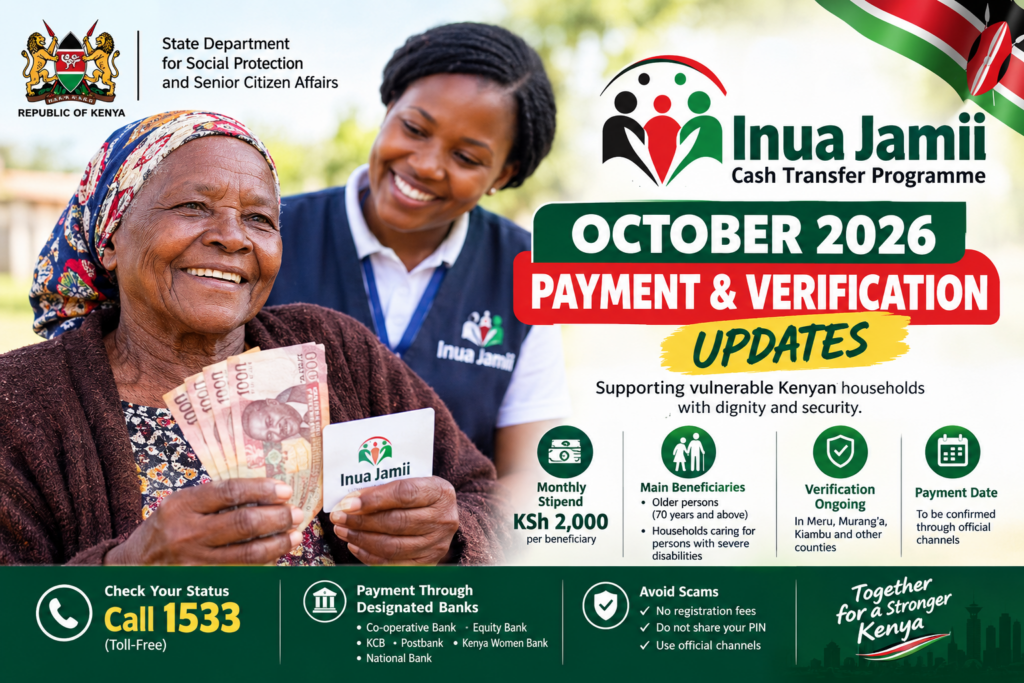
However, beneficiaries looking for the October 2026 payment date should distinguish between confirmed payment announcements and reports about verification. A verification announcement does not automatically mean that a new monthly payment has been released.
This article explains the latest available updates, the amount beneficiaries receive, how to check payment status, and what to do if your money has not arrived.
1. Inua Jamii Cash Transfer October 2026 Payment Update
The latest October 2026 developments include an ongoing beneficiary verification exercise designed to improve the administration of the Inua Jamii programme.
According to the Kenya News Agency, verification activities were taking place in different parts of the country in early October.
In Murang’a County, authorities reported a verification exercise targeting more than 60,000 beneficiaries. In Meru County, beneficiaries in Igembe South were also participating in a proof-of-life exercise.
The government initiative aims to confirm that registered beneficiaries remain eligible and to update records where necessary.
What does this mean for October payments?
Beneficiaries should keep the following points in mind:
- Monthly stipend: The standard Inua Jamii benefit is KSh 2,000 per eligible beneficiary per month.
- Payment date: An official October 2026 payment date should be confirmed through a government announcement or the Inua Jamii helpline.
- Verification: Beneficiaries who have been contacted about verification should follow the official instructions provided in their area.
- Delayed payments: Beneficiaries who have not received their money should contact the programme’s official support channels.
- Payment eligibility: Continued payment depends on the beneficiary’s status and compliance with applicable programme requirements.
As of this article’s publication, the available reports confirm that verification is underway, but they do not establish a nationwide October payment release date.
For the latest information, visit the official State Department for Social Protection website at https://www.socialprotection.go.ke/.
2. How Much Does Inua Jamii Pay in October 2026?
The standard Inua Jamii cash transfer is KSh 2,000 per month for each eligible beneficiary.
The programme provides financial assistance to vulnerable households to help them meet essential needs, including food, healthcare, and other basic expenses.
The amount received depends on the beneficiary’s eligibility and payment status.
| Payment Detail | Information |
|---|---|
| Programme name | Inua Jamii Cash Transfer |
| Country | Kenya |
| Standard monthly stipend | KSh 2,000 |
| Main beneficiaries | Older persons aged 70 and above and eligible households caring for persons with severe disabilities |
| Responsible government department | State Department for Social Protection and Senior Citizen Affairs |
| Payment method | Designated payment channels, including contracted banks and programme payment arrangements |
| October 2026 payment date | Confirm through official government channels |
| Official toll-free helpline | 1533 |
Important: Do not assume that a payment has been released simply because a previous month’s payment was announced. Check the latest official communication for the specific payment cycle.
3. What Is the Inua Jamii Beneficiary Verification Exercise?
One of the significant developments in October 2026 is the ongoing beneficiary verification exercise, commonly referred to as proof-of-life verification.
The exercise is intended to improve the accuracy of the programme’s beneficiary register and reduce the risk of payments being made to people who are no longer eligible.
Why is the government conducting verification?
The exercise helps authorities to:
- Confirm the identity of registered beneficiaries.
- Establish whether beneficiaries remain eligible.
- Update beneficiary and caregiver records.
- Identify records that need correction.
- Reduce irregular payments.
- Improve accountability in the distribution of public funds.
Where is verification taking place?
October 2026 reports have highlighted activities in several counties.
Murang’a County: A verification exercise began in September and was scheduled to continue through October. The exercise targeted beneficiaries across the county’s sub-counties.
Meru County: In Igembe South, officials reported that beneficiaries were participating in verification activities beginning on October 1, 2026.
Kiambu County: Local authorities also reported a 30-day verification exercise that began in September 2026.
These reports demonstrate that verification is taking place in different locations. However, beneficiaries should not assume that the dates or arrangements in one county automatically apply to every other county.
What should beneficiaries do?
If you receive an official notice requiring verification:
- Contact your local social protection officer or chief to confirm the exercise details.
- Ask where and when verification will take place in your area.
- Follow the official instructions concerning identification documents and biometric checks.
- Attend the designated verification point or follow any approved alternative arrangement.
- Keep any official confirmation or reference details provided.
Older persons and beneficiaries with mobility challenges should ask local officials whether assistance or a nearby verification point is available.
Do not share your PIN, passwords, or mobile money security codes with anyone claiming to conduct verification.
4. Who Qualifies for Inua Jamii Cash Transfers?
The Inua Jamii programme supports vulnerable Kenyan citizens who meet the eligibility requirements of the relevant cash transfer category.
Two major categories include the Older Persons Cash Transfer and the Persons with Severe Disabilities Cash Transfer.
A. Older Persons Cash Transfer
This category targets eligible older Kenyans aged 70 years and above.
The official programme eligibility criteria include:
- Kenyan citizenship.
- Age of at least 70 years.
- A valid Kenyan national identity card.
- Not receiving a pension.
- A caregiver with a valid Kenyan national identity card, where required by the programme.
- Having lived in the relevant location for at least one year.
Applicants must satisfy the applicable programme requirements before being enrolled.
B. Persons with Severe Disabilities Cash Transfer
This category supports eligible extremely poor households caring for persons with severe disabilities.
The official criteria include:
- The household must be extremely poor.
- The household must care for a person or persons with severe disabilities.
- The beneficiary must be a Kenyan citizen.
- The household must have existed in the relevant location for at least one year.
- The household must meet the programme’s rules on participation in other cash transfer programmes.
The government assesses applications against the relevant eligibility requirements.
Meeting the general criteria does not automatically guarantee immediate registration or payment.
5. How to Check Inua Jamii Payment Status in October 2026
If you are an existing beneficiary and want to know whether your October payment is available, use official programme channels.
Method 1: Call the Inua Jamii helpline
The government provides a toll-free Inua Jamii helpline on 1533.
You can contact the helpline to ask about:
- Payment dates and payment delays.
- Missing beneficiaries on the payroll.
- Account opening and payment-card issues.
- Registration and targeting questions.
- Updates to beneficiary records.
- Complaints concerning cash transfer services.
When calling, explain your concern clearly and follow the instructions given by the official support team.
Method 2: Contact your local social protection officer
Visit or contact your local social protection office if you need help with your beneficiary records or verification requirements.
You can ask the officer to clarify whether:
- Your records require updating.
- A verification exercise is taking place in your area.
- Your payment details need correction.
- Your name appears on the relevant beneficiary register.
- Further action is required before your case can be resolved.
Carry your identification documents when attending an in-person appointment, as instructed by the relevant office.
Method 3: Contact your designated payment bank
Inua Jamii payments are processed through designated banking arrangements. If the government indicates that your payment has been released but you cannot access the money, contact the bank where your programme account is held.
Ask the bank to establish whether the funds have been credited and whether there is an account, card, or biometric authentication problem.
The official programme information identifies the following contracted banks:
- Co-operative Bank of Kenya.
- Equity Bank Kenya.
- Kenya Commercial Bank.
- Kenya Post Office Savings Bank (Postbank).
- Kenya Women Microfinance Bank.
- National Bank of Kenya.
Confirm your own designated payment provider before visiting a bank or agent.
6. How Are Inua Jamii Payments Disbursed?
The programme uses electronic government-to-bank payment arrangements to distribute funds to registered beneficiaries.
Under the established banking arrangements, funds are credited to the beneficiary’s or authorised caregiver’s programme account.
Beneficiaries can generally access their money through authorised agents of their designated bank or at the bank where their account is held.
The programme’s official frequently asked questions also describe biometric authentication for transactions.
What if you cannot withdraw your money?
If you cannot access your funds, consider these steps:
- Confirm whether the payment for your particular cycle has been released.
- Visit an authorised payment agent or your designated bank.
- Ask whether your account is active.
- If biometric authentication fails, request assistance from the bank.
- If the issue remains unresolved, contact the Inua Jamii helpline on 1533.
Avoid making repeated trips without first checking whether the payment has been released or whether your account requires attention.
7. What Happens if Your Inua Jamii Payment Is Delayed?
Payment delays can cause difficulties for households that depend on the monthly stipend to meet essential expenses.
If you have not received your expected payment in October 2026, do not immediately assume that your benefits have been cancelled.
Several issues may require investigation, including:
- The payment cycle has not yet been officially released.
- Your bank account is inactive or dormant.
- Your beneficiary details require updating.
- A verification process is pending.
- There is a banking or transaction-processing problem.
- Your record requires review by the relevant programme office.
Steps to take when a payment is missing
Step 1: Confirm the official payment announcement.
Check the government’s latest communication to establish whether funds have been released for the relevant cycle.
Step 2: Check your payment account.
Contact your designated bank or authorised payment agent to establish whether the money has been credited.
Step 3: Confirm your beneficiary records.
If you have been asked to participate in verification, contact the relevant local office to confirm what action is required.
Step 4: Report the issue.
Call the toll-free Inua Jamii helpline on 1533 or contact the relevant social protection officer.
Step 5: Keep a record of your complaint.
Write down the date you reported the issue and any reference number or instructions provided.
These steps can help you identify whether the problem relates to the payment schedule, beneficiary records, or access to your bank account.
8. What Happens if an Inua Jamii Bank Account Becomes Dormant?
An inactive account can make it difficult for a beneficiary to access funds.
According to the programme’s official frequently asked questions, an account may become inactive after six months without a transaction. The published guidance also explains that beneficiaries may need to visit their bank in person for biometric reactivation if an account becomes dormant.
If your account has been inactive for an extended period, contact your designated bank before travelling to establish the documents and steps required.
You should also ask the bank or programme office whether any unclaimed funds remain available and what procedure applies to your case.
Do not assume that a dormant account automatically means permanent removal from the programme. Ask the relevant officials to review your individual circumstances.
9. Will Beneficiaries Who Miss Verification Still Receive Payments?
Beneficiaries should take verification notices seriously.
The purpose of proof-of-life verification is to confirm that registered beneficiaries remain eligible and that programme records are accurate.
October 2026 reports indicate that authorities have warned that failure to participate in required verification may affect a beneficiary’s status or payments.
However, the consequences and applicable deadlines may differ depending on the official instructions issued for the relevant exercise.
If you missed a verification appointment because of illness, disability, transport difficulties, or another genuine reason, contact your local social protection officer as soon as possible.
Ask whether a further appointment, an alternative verification arrangement, or another approved procedure is available.
Do not wait until your payment is interrupted before seeking clarification.
10. Is Inua Jamii Registration Open in October 2026?
Registration depends on the government’s targeting process and the availability of an official registration exercise.
Being eligible for the programme does not necessarily mean that applications are open in every county at the same time.
People who believe they qualify should contact their local social protection office to ask:
- Whether a registration exercise is taking place.
- Which programme category they may qualify for.
- What documents are required.
- How the targeting and assessment process works.
- Whether their household is already registered.
Avoid relying on unofficial social media posts that promise guaranteed registration or immediate payments.
The government does not guarantee enrolment simply because someone submits personal information to an online form.
11. How to Avoid Inua Jamii Cash Transfer Scams
People seeking government assistance can be targeted by fraudsters who promise faster payments, guaranteed registration, or additional financial support.
The government has previously warned about fraudulent schemes using names such as Inua Jamii Foundation Empowerment.
Beneficiaries should be careful when receiving messages or calls claiming to offer special access to government cash transfers.
Warning signs to watch for
Be cautious if someone:
- Requests a registration fee before releasing your cash transfer.
- Promises guaranteed approval in exchange for money.
- Asks for your M-Pesa PIN or banking password.
- Requests a mobile money security code.
- Claims to be an official and demands payment through a personal number.
- Sends an unfamiliar link requesting sensitive personal information.
- Promises an additional grant without a verifiable government announcement.
How to protect yourself
- Use official government communication channels.
- Contact the Inua Jamii helpline on 1533 to verify suspicious claims.
- Do not pay an unofficial person to secure your place on the beneficiary register.
- Never disclose your PIN or one-time password.
- Verify registration and payment announcements before sharing personal information.
- Report suspicious requests to the appropriate authorities.
Remember that a message containing the programme’s name or government-related language is not proof that it is genuine.
12. Official Inua Jamii Contacts and Support
Beneficiaries who need help with payment delays, verification, registration, or account issues can use the following channels.
| Support Channel | Details |
|---|---|
| Inua Jamii toll-free helpline | 1533 |
| Responsible department | State Department for Social Protection and Senior Citizen Affairs |
| Official website | https://www.socialprotection.go.ke/ |
| Published programme email | inuajamii@socialprotection.go.ke |
| Physical office | Social Security House, Bishop Road, Nairobi |
| General telephone | +254 (0) 2729800 |
The official helpline can assist with payment-date enquiries, account-opening concerns, beneficiary records, missing payroll entries, and complaints.
For sensitive matters, use the contact information published by the government rather than details supplied by an unverified social media account.
13. Frequently Asked Questions About Inua Jamii October 2026
1. Has the Inua Jamii October 2026 payment been released?
The available October reports confirm that beneficiary verification exercises are underway in several counties. They do not, by themselves, confirm a nationwide October payment release. Check the latest official announcement or call 1533 for the payment status.
2. How much is the Inua Jamii monthly payment in 2026?
The standard stipend is KSh 2,000 per eligible beneficiary per month.
3. When will Inua Jamii beneficiaries receive their October 2026 money?
The payment date should be confirmed through an official government announcement. Beneficiaries should not rely on unverified social media messages or assume that a verification exercise is also a payment announcement.
4. What is the Inua Jamii helpline number?
The official toll-free Inua Jamii helpline is 1533.
5. Who qualifies for Inua Jamii?
The main categories include eligible Kenyan citizens aged 70 and above who meet the Older Persons Cash Transfer requirements, and eligible extremely poor households caring for people with severe disabilities.
6. Is Inua Jamii conducting verification in October 2026?
Yes. October reports from counties including Meru, Murang’a, and Kiambu describe ongoing beneficiary verification activities. Beneficiaries should confirm the applicable dates and arrangements with their local social protection offices.
7. What documents should I carry for beneficiary verification?
Follow the instructions issued for your specific exercise. Official reports have described verification involving physical appearance, original national identity cards, and biometric checks. Contact your local office if you are unsure what is required.
8. What should I do if my Inua Jamii money has not arrived?
Confirm whether the payment cycle has been released, check with your designated bank, and contact the Inua Jamii helpline on 1533 if the issue remains unresolved.
9. Can I receive Inua Jamii payments if my bank account is dormant?
You may need to reactivate your account before accessing your money. Contact your designated bank to confirm the applicable procedure, including any biometric verification requirements.
10. Does Inua Jamii charge a registration fee?
Do not pay unofficial individuals who promise guaranteed registration or faster payment. Verify any official charges or administrative requirements directly with the government.
11. Can a caregiver help with verification?
Caregiver arrangements depend on the beneficiary category and the instructions for the specific exercise. Contact the local social protection office to confirm whether the caregiver must attend and what identification is required.
12. Where can I find the latest Inua Jamii updates?
Visit the official State Department for Social Protection website or call the toll-free helpline on 1533. These channels are appropriate starting points for confirming payment announcements and resolving beneficiary concerns.
Conclusion
The latest Inua Jamii Cash Transfer updates for October 2026 highlight the government’s ongoing efforts to verify beneficiaries, update programme records, and improve the accountability of social protection payments.
Eligible beneficiaries continue to be covered by the programme’s standard KSh 2,000 monthly stipend. However, the exact October payment date should be confirmed through official government communication rather than inferred from reports about verification.
If you are an existing beneficiary, check whether any verification instructions apply to you, keep your beneficiary records up to date, and contact your designated bank if you have difficulty accessing your money.
For payment-date enquiries, missing payments, registration questions, or complaints, call the official Inua Jamii toll-free helpline on 1533.
Disclaimer: This article provides general information based on available programme guidance and published reports as of October 2026. Payment schedules, eligibility decisions, and verification arrangements may change. Always confirm important details with the State Department for Social Protection and Senior Citizen Affairs.