Find out the latest HELB minimum monthly repayment amount in 2026, when repayment begins, interest rates, penalties, M-PESA payment options, and how to check your HELB balance and clearance status.
The Higher Education Loans Board (HELB) has clarified the minimum amount borrowers can pay when servicing their student loans through small, regular instalments.
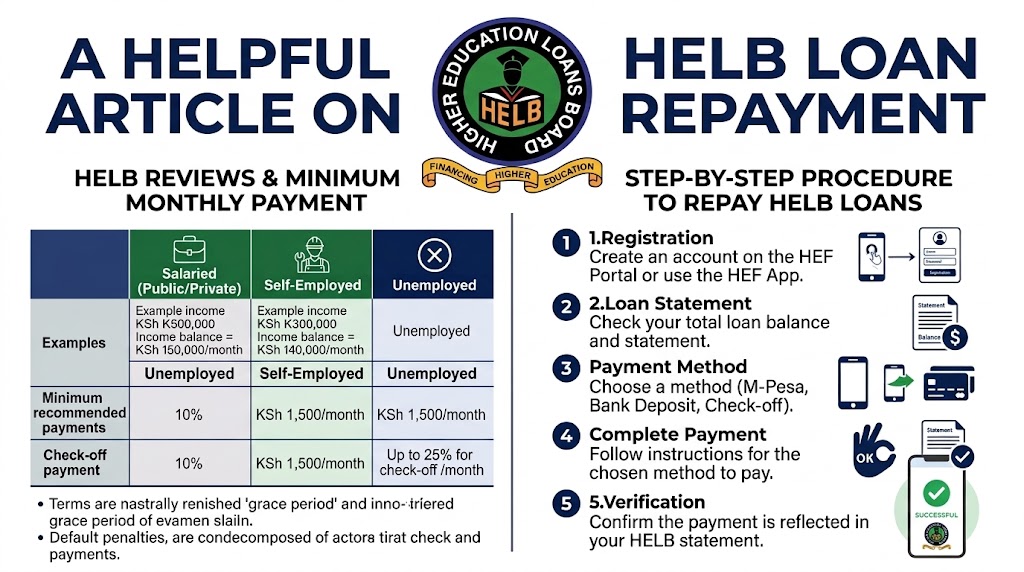
For borrowers who prefer to repay their HELB loan “mdogo mdogo”, HELB has recommended a minimum monthly payment of KSh 1,500.
The clarification is particularly important for graduates who may not have enough money to make large repayments at once. Paying KSh 1,500 every month can help borrowers maintain regular repayment activity while gradually reducing their outstanding balance.
Recent reporting on the clarification indicates that HELB recommended KSh 1,500 per month for borrowers making instalment payments.
However, borrowers should understand that KSh 1,500 is a recommended minimum for “mdogo mdogo” repayments, rather than an indication that every HELB account has exactly the same repayment schedule. Your actual obligation may depend on your loan type, outstanding balance, repayment arrangement and employment status.
What Is the HELB Minimum Monthly Payment?
The latest clarification puts the recommended minimum monthly payment for borrowers making small instalment payments at:
KSh 1,500 per month
This means a borrower who cannot afford a large lump-sum payment can use regular KSh 1,500 payments as a way of servicing the loan.
For example:
| Monthly Payment | Approximate Payments Per Year |
|---|---|
| KSh 1,500 | KSh 18,000 |
| KSh 2,000 | KSh 24,000 |
| KSh 3,000 | KSh 36,000 |
| KSh 5,000 | KSh 60,000 |
| KSh 10,000 | KSh 120,000 |
These figures are simply the total amount paid before considering interest, fees or any other applicable charges. They should not be interpreted as a calculation of how quickly a particular HELB loan will be cleared.
When Does HELB Loan Repayment Begin?
One of the most important things borrowers need to understand is that HELB repayment is not dependent on getting a formal job.
For undergraduate loans, HELB states that repayment begins within one year after completion of studies, or within another period determined by the Board if it recalls the loan earlier. Borrowers can also make voluntary payments before or after completing their studies to reduce their outstanding balance.
This means that graduating without immediately finding employment does not automatically cancel or postpone the repayment obligation.
If you are approaching or have passed the end of the repayment grace period, it is advisable to check your HELB account and establish your current balance and repayment status.
Can Unemployed Graduates Pay HELB in Small Instalments?
Yes. The recent KSh 1,500 clarification is particularly relevant to borrowers who want to make small regular payments.
An unemployed graduate may choose to make voluntary repayments rather than wait until they secure formal employment.
The important point is consistency.
For example, instead of waiting several months and trying to raise a large amount of money, a borrower who can afford it may choose to pay KSh 1,500 every month.
However, borrowers should check their individual HELB statement and repayment requirements because interest and applicable charges can affect the outstanding balance.
How Much Does HELB Deduct From a Salaried Employee?
Borrowers in formal employment may have their repayments handled through an employer check-off arrangement.
HELB’s employer guidance indicates that employers receive the applicable monthly deduction information through the employer system.
The commonly cited HELB repayment guideline is that monthly deductions should not exceed 25% of a loanee’s basic salary. This should be understood as a maximum deduction limit rather than a standard deduction rate for every employee.
Therefore, a salaried borrower should not automatically assume that HELB will deduct 25% of their salary every month. The actual amount can depend on the loan account and repayment arrangement.
Example
If a borrower has a basic salary of KSh 40,000:
25% × KSh 40,000 = KSh 10,000
The 25% figure would therefore represent KSh 10,000 as the maximum under the cited guideline—not necessarily the amount that HELB will actually deduct.
HELB Interest Rate in 2026
HELB’s undergraduate loan currently attracts 4% interest per year. HELB’s official undergraduate-loan information confirms the 4% rate, while the Board also issued a clarification in August 2026 reaffirming that the HELB loan interest rate remains at 4%.
Borrowers should therefore avoid looking only at the amount they originally borrowed. The balance can also reflect applicable interest and other charges associated with the loan.
What Happens If You Stop Repaying HELB?
Failing to service a mature HELB loan can result in penalties.
HELB’s published materials state that a penalty of not less than KSh 5,000 may be charged for each month a non-performing loan remains unserviced, subject to applicable policy and exceptions.
This is why borrowers should not simply ignore a HELB balance because they are unemployed or experiencing financial difficulties.
If you cannot afford a large repayment, making regular payments and communicating with HELB about your account may be a better approach than allowing the account to remain completely unserviced.
Is KSh 1,500 Enough to Clear Your HELB Loan?
It depends on your outstanding balance, interest and applicable charges.
Suppose, purely as an illustration, a borrower owes KSh 150,000 and pays KSh 1,500 every month.
Over 12 months:
KSh 1,500 × 12 = KSh 18,000
That does not mean the balance will automatically fall by exactly KSh 18,000 because the account may continue to accrue interest and may contain applicable charges.
A borrower who can afford to pay more can potentially reduce the outstanding balance faster.
Why Paying More Can Help
If your financial situation allows, you may consider paying more than the KSh 1,500 recommended minimum.
For example:
- KSh 1,500 monthly = KSh 18,000 annually
- KSh 3,000 monthly = KSh 36,000 annually
- KSh 5,000 monthly = KSh 60,000 annually
Making additional voluntary payments can help reduce the outstanding debt and potentially shorten the repayment period.
How to Repay HELB in 2026
HELB has transitioned its repayment process to the e-Citizen payment gateway. The Board currently provides several repayment channels, including USSD, the HELB Mobile App and the HELB self-service portal.
Option 1: Repay HELB Through *642#
You can use the HELB USSD service to initiate repayment.
- Dial *642#.
- Log in or register if required.
- Select Loan Repayment.
- Select the repayment option.
- Choose M-PESA.
- Select whether to pay the full amount or a specific amount.
- Enter your desired amount, such as KSh 1,500.
- Confirm the transaction.
- Follow the e-Citizen payment prompt.
- Enter your M-PESA PIN when prompted.
HELB’s official repayment instructions confirm that *642# can be used to access loan repayment and that an e-Citizen notification provides the payment details after initiating the transaction.
Option 2: HELB Self-Service Portal
Borrowers can also use the HELB/HEF self-service portal.
The official process is:
- Log in to the HELB/HEF portal.
- Select the Self-Serve option.
- Choose Loan Repayment.
- Select Make Payment.
- Enter the amount you want to pay.
- Click Pay.
- Confirm the payment details.
- Select your preferred payment method.
- Complete the transaction.
- Check your account later to confirm that the payment has been posted.
HELB lists the self-service portal as one of its official repayment platforms.
Option 3: Pay HELB Through M-PESA PayBill
The traditional HELB M-PESA payment details remain widely used:
PayBill: 200800
Account Number: Your National ID number
Safaricom’s published PayBill partner information lists Higher Education Loans Board (HELB) under PayBill number 200800.
Before confirming any payment, always verify the recipient and payment details on the official HELB channels. HELB has previously warned the public about fraudulent accounts impersonating the institution.
How to Check Your HELB Loan Balance
Knowing your outstanding balance is important before deciding how much to pay each month.
HELB provides a loanee portal where borrowers can access their loan balance, repayment statement, compliance information and clearance services.
You should regularly check:
- Outstanding principal
- Accrued interest
- Applicable penalties or charges
- Amount already repaid
- Current repayment status
- Remaining balance
This helps you avoid relying on an old SMS or personal calculations when deciding how much you still owe.
What Happens After You Finish Paying HELB?
Finishing your final repayment does not mean you should simply stop there.
HELB advises borrowers to seek formal clearance after completing repayment. The Board—not an employer—confirms the final repayment status and issues the relevant clearance documentation.
HELB states that borrowers who have fully repaid their loans can receive a Certificate of Clearance.
The Board also provides Compliance Certificates for beneficiaries who are up to date with their repayments and for people who have never benefited from a HELB loan.
HELB Clearance vs Compliance Certificate
These two documents are related but should not be confused.
HELB Compliance Certificate
A compliance certificate can be issued to a HELB beneficiary who is up to date with repayments or is still within the applicable repayment grace period.
It can also be issued to someone who has never benefited from a HELB loan. HELB says the service is not charged.
HELB Certificate of Clearance
A Certificate of Clearance is issued after the beneficiary has completely repaid the HELB loan.
Therefore, if you have finished paying your loan, apply for clearance rather than assuming that your final M-PESA transaction automatically serves as proof of full settlement.
Important Tips for HELB Borrowers
1. Do not wait until you get a job
HELB repayment obligations can begin after the applicable repayment period even when you are not formally employed.
2. Pay consistently
If you can afford KSh 1,500, regular payments may be preferable to ignoring the account altogether.
3. Pay more when you can
If your income improves, additional payments can help reduce your outstanding balance faster.
4. Keep payment records
Save M-PESA messages, e-Citizen payment confirmations and other transaction records until the payment appears correctly on your HELB statement.
5. Check your statement
Do not rely solely on your memory of how much you have paid. Use the official HELB portal to monitor your account.
6. Be careful with payment scams
Use official HELB channels when making repayments. Do not send money to a number supplied through an unofficial social-media account or WhatsApp message.
7. Apply for the correct certificate
Once the loan is completely repaid, apply for the HELB Certificate of Clearance. If you are still repaying but remain compliant, you may instead need a Compliance Certificate.
Frequently Asked Questions About HELB Minimum Payment
What is the minimum HELB monthly payment in 2026?
HELB has recommended a minimum payment of KSh 1,500 per month for borrowers who want to repay their loans through small instalments or “mdogo mdogo” payments.
Can I pay more than KSh 1,500?
Yes. Borrowers can make larger voluntary payments, subject to their individual repayment arrangements. Paying more can help reduce the outstanding balance faster.
Does HELB repayment start when I get a job?
Not necessarily. For undergraduate loans, HELB states that repayment starts within one year after completion of studies or within another period determined by the Board.
What is the HELB interest rate?
The undergraduate HELB loan interest rate is 4% per annum. HELB reaffirmed the 4% rate in August 2026.
What happens if I do not repay my HELB loan?
A non-performing account can attract penalties. HELB’s published information states that a penalty of not less than KSh 5,000 per month may apply to non-performing loans, subject to applicable policy.
What is the HELB M-PESA PayBill number?
The HELB M-PESA PayBill number is 200800, with the borrower’s National ID used as the account number.
Can I repay HELB through *642#?
Yes. HELB currently lists *642# as an official USSD repayment channel.
What happens after I clear my HELB loan?
After completing repayment, you should seek official confirmation and apply for a HELB Certificate of Clearance.
Final Takeaway
The latest HELB clarification gives borrowers who prefer “mdogo mdogo” repayment a practical starting point: KSh 1,500 per month.
However, borrowers should not view KSh 1,500 as a universal repayment schedule for every HELB account. Your actual repayment situation depends on your loan, balance, employment status and applicable terms.
The most important steps are to start repayment when it becomes due, make payments consistently, monitor your HELB statement, avoid unnecessary penalties and obtain official clearance after the loan has been fully repaid.
For the most accurate and current information, borrowers should use HELB’s official repayment and self-service channels rather than relying on third-party payment instructions.